

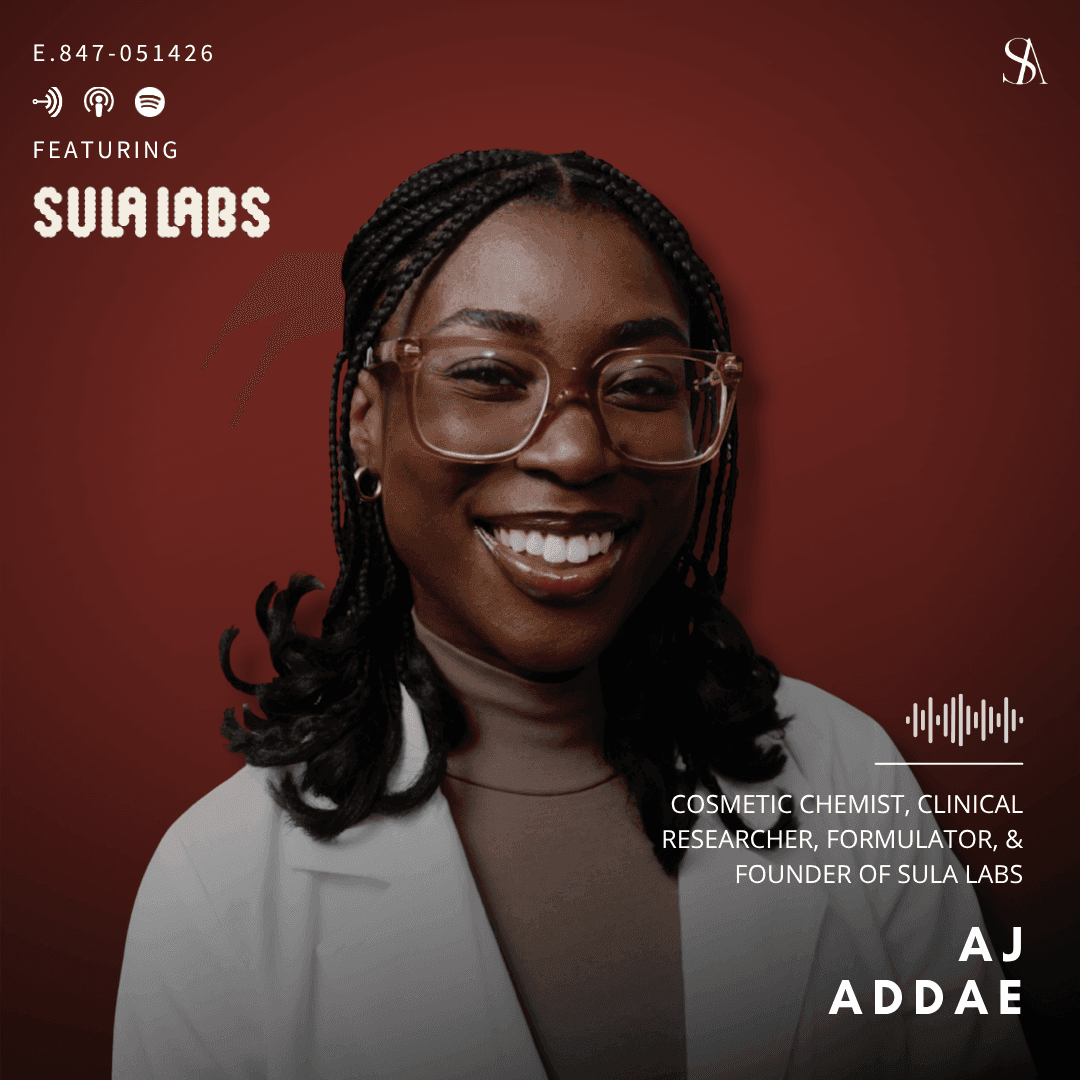
In this episode of Skin Anarchy, award-winning cosmetic chemist and clinical researcher AJ Addae joins the conversation to unpack one of the beauty industry’s most overlooked scientific challenges: why sunscreen still fails so many consumers, especially people with deeper skin tones. What follows is a deep dive into formulation chemistry, particle optics, inclusivity in cosmetic science, and the future of sunscreen innovation.
Growing Up Between Science and Beauty
AJ’s relationship with beauty began long before her professional career in cosmetic chemistry. Growing up as a dark-skinned daughter of immigrants, she experienced firsthand what it felt like to navigate an industry that often failed to acknowledge deeper skin tones and textured hair. Hyperpigmentation, irritation, and exclusion from mainstream beauty messaging became part of her early relationship with skincare.
Even as a child, she was already trying to solve these gaps. At just 11 years old, she was anonymously writing beauty tutorials online for darker skin tones, including articles about creating lip balms that complemented dual-toned lips. At the same time, she was being raised in an academically rigorous household where science was expected to be part of her future.
While studying biology at Northeastern University, AJ found herself pulled between science and creativity. That tension eventually led her into cosmetic formulation, where she realized beauty could become a meaningful intersection between chemistry, consumer experience, and cultural representation.
Why Sunscreen Inclusivity Still Falls Short
One of the most powerful parts of the episode centers around AJ’s experience developing sunscreens in professional labs and realizing how often “inclusive” formulations were being approved without ever being tested on deeper skin tones.
She explains that many sunscreen formulas looked acceptable on Fitzpatrick skin types I and II, yet left obvious white casts on deeper complexions. The issue was not simply marketing — it was rooted in the physical properties of zinc oxide and titanium dioxide themselves.
Unlike organic UV filters, mineral filters exist as suspended particles. Those particles naturally aggregate and scatter visible light, which creates the chalky white cast many consumers experience. AJ explains that when these particles cluster together, the visible light scattering intensifies, making formulas appear even more opaque on skin.
This realization became the foundation of her research.
The Science of Zinc Oxide, Particle Shape, and White Cast
Rather than abandoning mineral sunscreens altogether, AJ became fascinated by the optical behavior of zinc oxide itself. Specifically, she began exploring how changing particle shape — not just particle size — could influence sunscreen wearability.
Her research focused on a specialized zinc oxide structure called a tetrapod. Unlike traditional spherical zinc oxide particles, tetrapods have branching appendages that prevent the particles from fully collapsing into dense aggregates. This changes how light scatters across the skin and creates a more porous, evenly distributed film.
The result is a sunscreen that still provides meaningful UV protection while dramatically reducing visible white cast.
AJ explains that the innovation is not simply cosmetic. Better dispersion and reduced aggregation also improve suspension stability and spreadability, which are essential for maintaining consistent sunscreen performance over time.
Most importantly, this work demonstrates that inclusivity in sunscreen requires more than simply adding pigment or darker tinting agents. It requires rethinking the underlying chemistry itself.
Why SPF Testing Doesn’t Tell the Full Story
Another major theme throughout the episode is the disconnect between how sunscreen is marketed and how SPF is actually measured.
AJ breaks down the reality of SPF testing, explaining that traditional SPF values are determined through controlled UVB exposure studies on human subjects. These tests primarily evaluate how long it takes skin to visibly redden under UV exposure — an endpoint that becomes problematic across diverse skin tones.
She also points out that SPF says very little about UVA protection or visible light protection, both of which are especially important when discussing hyperpigmentation and melanin-rich skin.
This becomes even more complicated when discussing sunscreen reapplication. Spray sunscreens, powders, and sticks often fail to create the continuous film necessary to achieve the SPF value printed on the packaging. In practice, most consumers significantly under-apply sunscreen, meaning they rarely receive the level of protection they think they are getting.
Her perspective throughout the conversation is refreshingly honest: sunscreen science is far more complex than most marketing allows consumers to understand.
Hyperpigmentation Is Still Deeply Misunderstood
One of the most important discussions in the episode revolves around hyperpigmentation and why the beauty industry continues to misunderstand it.
AJ argues that hyperpigmentation is not simply a surface-level issue that can be erased with aggressive exfoliation or “brightening” products. Inflammation, irritation, and barrier disruption are often major drivers of pigmentation itself — particularly in melanin-rich skin.
She reflects on how previous generations of skincare relied heavily on harsh ingredients, over-exfoliation, and stripping routines that frequently worsened long-term skin health. Even now, she believes many consumers unknowingly damage their skin barriers while chasing short-term cosmetic improvement.
Instead, she advocates for formulations that combine antioxidants, anti-inflammatory ingredients, thoughtful active balancing, and barrier support rather than relying solely on aggressive treatment strategies.
The Need for More Scientific Rigor in Beauty
Throughout the episode, AJ repeatedly returns to a larger issue within the beauty industry: the lack of rigorous scientific infrastructure.
She speaks candidly about how little formal funding exists for cosmetic science innovation despite the beauty industry generating billions of dollars annually. Compared to traditional biomedical research, cosmetic formulation science often lacks grants, academic support, and open-access collaboration.
For AJ, the future of beauty depends on treating cosmetic chemistry with the same seriousness as other scientific disciplines. That includes publishing research, improving testing standards, embracing transparency, and ensuring innovation is driven by evidence rather than trends.
A New Era for Cosmetic Chemistry
At its core, this episode reframes sunscreen as far more than a beauty product. It becomes a conversation about optics, chemistry, skin physiology, inclusivity, and public health.
AJ’s work highlights an important truth: meaningful innovation in beauty rarely begins with marketing. It begins in the lab — with people willing to challenge assumptions, rethink outdated systems, and ask harder scientific questions.
And when those innovations are built with inclusivity from the start, the entire industry moves forward.
To learn more about AJ Addae, visit her website and social media.
Don’t forget to subscribe to Skin Anarchy on Apple Podcasts, Spotify, or your preferred platform. Reach out to us through email with any questions.
FOLLOW OUR SOCIALS:
Apple Podcast: https://podcasts.apple.com/us/podcast/skincare-anarchy/id1522162686
Spotify Podcast: https://open.spotify.com/show/298oIu74qjd3pXaaBMDr19
Instagram: https://www.instagram.com/skincareanarchy/?hl=en
Facebook: https://www.facebook.com/skincareanarchhy/
Twitter: https://twitter.com/SkincareAnarchy
Reddit: https://www.reddit.com/r/Skincare_Anarchy/
LinkedIn: https://www.linkedin.com/company/skincareanarchy/
Pinterest: https://cz.pinterest.com/skincareanarchy/_created/
TikTok: https://www.tiktok.com/@skincareanarchy
Medium Blog: https://skincareanarchy.medium.com
Shop through our ShopMy Shelf!