

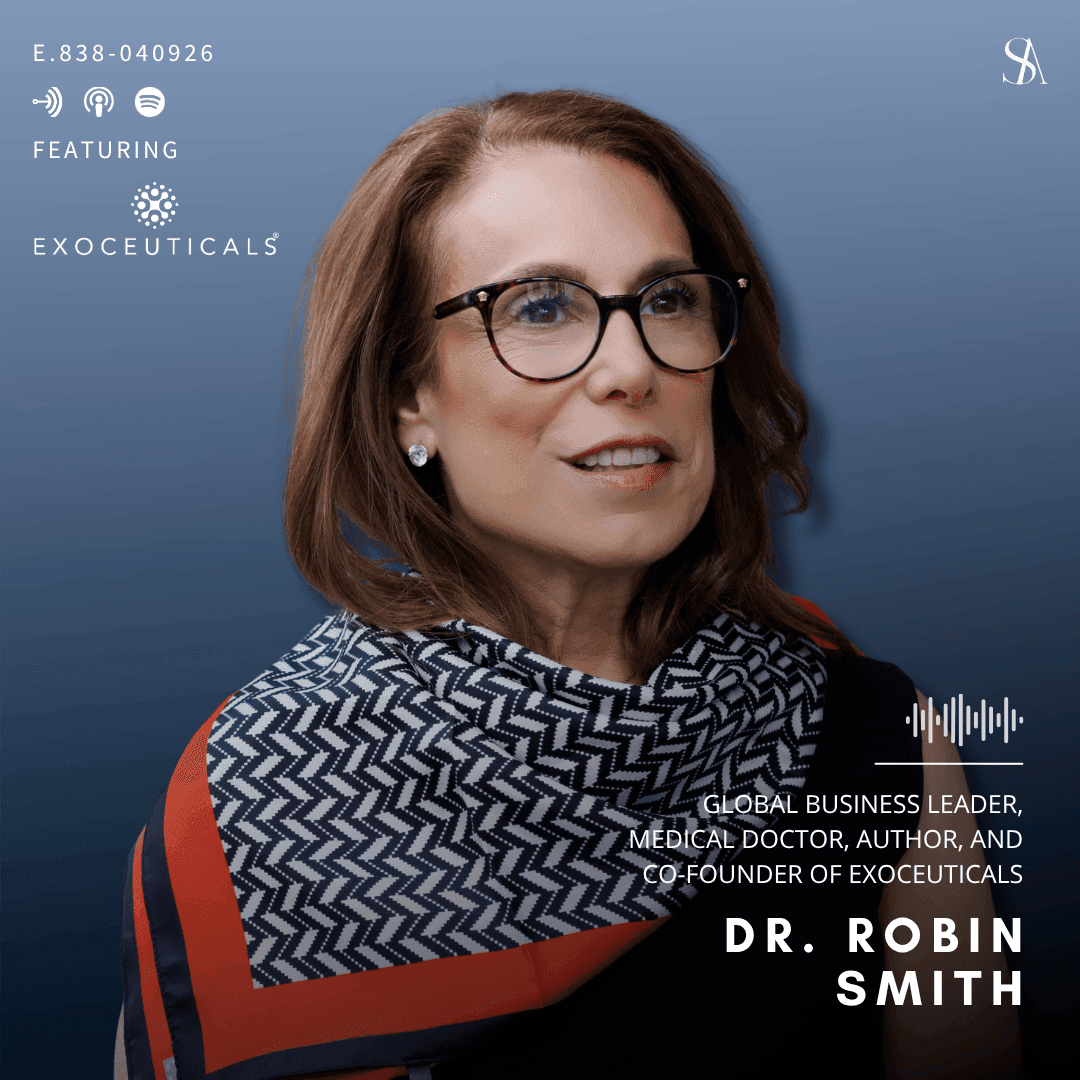
In this episode of Skin Anarchy, the conversation moves beyond traditional skincare and into something far more foundational: the biology of how skin actually functions—and how we can influence it at the cellular level.
Joined by Dr. Robin Smith, co-founder of Exoceuticals, the discussion explores the intersection of regenerative medicine and topical skincare. It’s a space that has long existed in clinical settings, but is now beginning to translate into consumer products in a meaningful way.
What becomes immediately clear is that this is not simply about better ingredients. It’s about a fundamentally different way of thinking.
From Regenerative Medicine to Skin
Dr. Smith’s background spans over three decades in regenerative medicine, with a focus on stem cells, immune signaling, and therapeutic development. The science itself is not new—procedures like bone marrow transplants have relied on stem cell biology for years. What is new, however, is how that knowledge is being adapted for broader applications, including skin health.
At the center of this evolution is a deeper understanding of cellular communication.
Rather than relying on whole cells, much of the focus has shifted toward exosomes—microscopic vesicles that act as messengers between cells. These structures carry both biological “instructions” and functional components, allowing cells to coordinate repair, regulate inflammation, and maintain tissue integrity.
In the context of skin, this opens up an entirely new framework. Instead of correcting damage after it appears, the goal becomes supporting the body’s own ability to repair and regulate itself.
Rethinking What Skincare Is Meant to Do
Historically, skincare has been reactive. Products were designed to smooth, brighten, or temporarily correct visible concerns. But as Dr. Smith explains, that model is increasingly outdated.
The shift now is toward preservation and function.
As the body ages, its ability to repair itself declines. Stem cells become less efficient, signaling pathways become dysregulated, and environmental stress compounds over time. The visible signs—fine lines, pigmentation, loss of elasticity—are downstream effects of these internal changes.
Regenerative skincare, in contrast, aims to intervene earlier in the process. The focus is not just on what the skin looks like, but on how it behaves.
The Complexity Behind “Biotech” Ingredients
One of the most important themes in the episode is the growing gap between scientific reality and market perception.
Terms like peptides, growth factors, and exosomes are often grouped together, but they function very differently. Peptides tend to act on specific pathways, offering targeted, short-term signaling effects. Stem cells, by contrast, are capable of replication and tissue generation. Exosomes sit somewhere in between—delivering complex signals and multiple functional components simultaneously.
But perhaps the most critical distinction is this: not all of these technologies are interchangeable, and not all are created equally.
Dr. Smith emphasizes that with exosomes in particular, sourcing, manufacturing, and dosing all matter. The idea that “more is better” is not only inaccurate—it can be counterproductive. Cellular systems rely on balance and specificity. Overloading signals can disrupt, rather than enhance, communication.
In other words, efficacy is not just about inclusion—it’s about precision.
The Missing Conversation: Safety and Standardization
As excitement around biotech skincare grows, so does concern—and not all of it is unfounded.
The episode addresses a key issue often overlooked in consumer conversations: safety protocols. When working with biologically derived materials, rigorous testing is non-negotiable. This includes screening for contaminants, ensuring stability, and validating biological activity over time.
Dr. Smith highlights that responsible development in this space requires the same level of scrutiny seen in clinical environments. Without that, claims quickly outpace credibility.
At the same time, she pushes back on blanket skepticism. The problem is not the category itself—it’s the inconsistency in how it is executed.
Why Context Matters More Than Age
Another nuance explored in the conversation is who these products are actually for.
There is a common assumption that advanced, regenerative ingredients are only relevant for aging skin. But as Dr. Smith explains, the need for repair is not strictly age-dependent. Environmental exposure, inflammation, hormonal changes, and lifestyle factors all influence how the skin functions.
In that context, regenerative support becomes less about correction and more about maintenance.
The question shifts from “How old are you?” to “What is your skin experiencing?”
Where Skincare Is Headed Next
What this episode ultimately reveals is that skincare is entering a new phase—one that is less about trends and more about translation.
Translation of clinical science into consumer use.
Translation of cellular biology into functional products.
Translation of long-term health into daily routines.
And with that comes a new level of responsibility—for brands, for educators, and for consumers themselves.
Because as these technologies become more accessible, understanding them becomes just as important as using them.
Listen to the full episode of Skin Anarchy to hear Dr. Robin Smith break down the science behind regenerative skincare, exosome technology, and what it really means to support skin at the cellular level.