

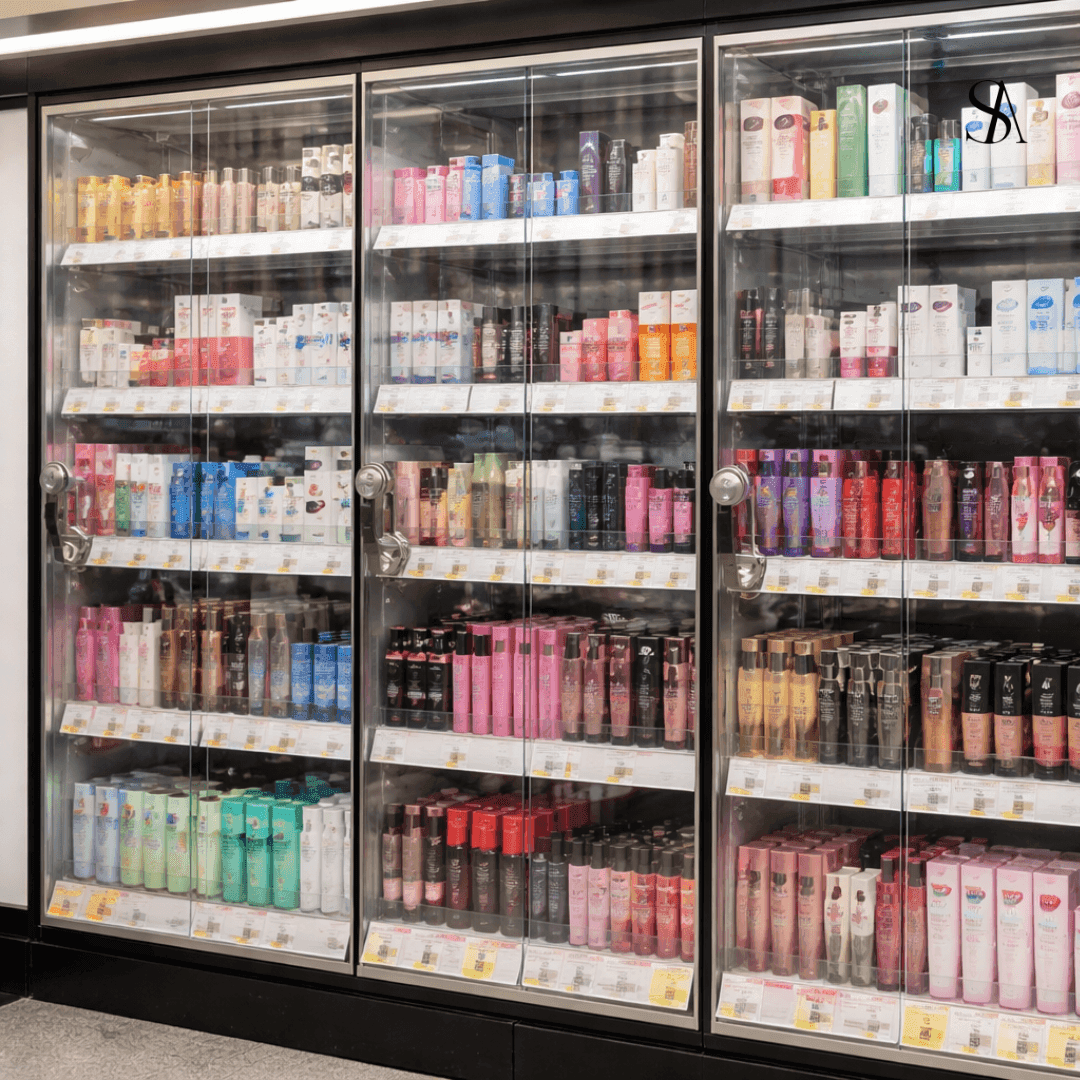
The New Drugstore Experience
Walk into a CVS or Walgreens with a simple intention, pick up a fragrance, a retinol serum, a new foundation, and you’re met with an unexpected barrier: a locked glass case.
The product is right there, visible and within reach. But accessing it now requires tracking down an employee, waiting for assistance, and completing what used to be a seamless interaction as a multi-step process.
Consumers are noticing, and changing their behavior accordingly. According to a November 2024 survey of more than 5,000 shoppers, three-fifths of consumers now regularly encounter locked merchandise. Of those, 27% will switch retailers or abandon the purchase entirely rather than wait. In beauty categories specifically, willingness to wait drops further, with only 53–56% of shoppers willing to stay for assistance (Numerator, 2024).
What was once an intuitive, impulse-driven experience has become friction-heavy. Drugstores built their identity on accessibility, but locked cases are actively eroding that core value, impacting not just retailers but the brands inside them.
Why Drugstores Started Locking Products
Retail Theft and Shrink
At the center of this shift is retail theft. The National Retail Federation reported that shrink reached $112.1 billion in 2022, up from $93.9 billion the year prior, with external theft accounting for 36% of losses (National Retail Federation, 2023).
Beauty products are particularly vulnerable: high-margin, easy to conceal, and widely resellable. Categories like fragrance, skincare, and cosmetics are frequent targets, especially within organized retail crime networks. Among retailers tracking ORC activity, incidents rose by an average of 57% from 2022 to 2023 (National Retail Federation, 2024).
The Trade-Off Retailers Are Making
Retailers like CVS, Walgreens, and Rite Aid have responded by locking up high-risk items, but even executives acknowledge the downside. Dollar Tree CFO Jeff Davis noted, “We don’t particularly care for it because we know that impacts sales.”
What often gets overlooked is the hidden cost: not just stolen inventory, but lost conversions, reduced browsing time, and long-term damage to consumer trust.
How Locked Cases Reshape Consumer Behavior
Friction Kills Impulse
Impulse purchasing, especially in beauty, is rooted in ease. It’s fast, emotional, and low-effort.
Behavioral economist Daniel Kahneman describes this as “System 1” thinking: quick, intuitive decision-making. (FS Blog)
Locked cases disrupt this entirely. The moment a shopper has to pause, find assistance, and wait, the purchase shifts into “System 2”, slower, more rational, and far more likely to result in abandonment. Retail data reflects this shift. Locked merchandise can reduce sales by up to 20%, and retrieving an item takes an average of 1.5 minutes, an eternity compared to the seconds it normally takes to decide on a beauty purchase (Indyme Solutions, 2021).
The Loss of Discovery
Beauty is inherently tactile. Consumers want to compare textures, read ingredient labels, and explore options side by side. According to McKinsey’s State of Fashion: Beauty report, in-store discovery remains one of the primary drivers of physical retail visits (McKinsey & Company, 2023).
Locked cases fundamentally interrupt that experience. Shoppers can see, but not engage and in that distinction matters in a category where discovery drives conversion.
The Psychological Effect
Beyond inconvenience, locked cases send a message. Retail environments perceived as high-surveillance consistently lead to shorter browsing times and lower satisfaction. Consumers move faster, engage less, and feel less comfortable.
61% of shoppers report seeing more locked merchandise than the year prior, with drugstores leading the trend (Numerator, 2024). As one retail analysis put it, locked cases act as a “visual merchandising nightmare” that subtly communicates distrust (One Door, 2024). When consumers feel monitored, they disengage.
What This Means for Drugstore Beauty BrandsThe Death of Impulse Buying
Drugstore beauty brands, L’Oréal, Maybelline, Neutrogena, CeraVe, e.l.f., NYX, have historically thrived on impulse. What was meant to be a quick drugstore trip, often turns into a basket of extras: a mascara, a serum, a lip gloss. It’s these small and unplanned purchases drive significant volume. But when products are locked away, that spontaneity disappears.
Shoppers unwilling to wait for assistance spend 21% of their beauty budget online, compared to 18% for those who complete in-store purchases (Numerator, 2024). That gap may seem small, but at scale, it represents a meaningful migration away from physical retail.
The Acceleration of E-Commerce
The shift toward online is already well underway.
Amazon’s beauty and personal care category is projected to reach $36 billion in 2024, growing 26% year-over-year, outpacing overall platform growth (Momentum Commerce, 2024). The platform now accounts for roughly 60% of U.S. beauty e-commerce sales (Euromonitor, cited by Front Row). At the same time, drugstore market share is declining. TD Cowen projects it will drop from 5% in 2024 to just 3% by 2030.
Locked cases don’t just slow down purchases, they push consumers toward alternatives that are faster, easier, and increasingly preferred.
Competitive Pressure from Prestige Retail
The contrast becomes even clearer when compared to Sephora and Ulta. These retailers prioritize open access and product testing. Their environments are designed to encourage exploration, not restrict it. Therefore younger consumers are responding accordingly. Gen Z and Millennials over-index at Sephora, Ulta, and Target, not drugstores (NielsenIQ).
The risk isn’t just losing a single transaction, it’s introducing consumers to a better experience, and giving them no reason to come back.
The Identity Crisis of Drugstore Retail
Drugstores have long occupied a unique space: not the cheapest, not the most curated, but the most accessible. They are the “in-between” store and the convenient option. But locked merchandise challenges that identity. 62% of drugstore shoppers now encounter locked products, the highest of any retail format (Numerator, 2024).
If access requires assistance, if browsing feels restricted, if the environment signals surveillance, the drugstore is no longer defined by ease.
Where Retailers Go From Here
The solution isn’t as binary as open shelves versus locked cases.
Smarter Technology
Retailers are beginning to experiment with mobile unlock systems, allowing shoppers to access products using their phone number, removing friction while maintaining security. Companies like Kroger and Walmart are already piloting these systems (CNN Business, 2024).
AI-driven loss prevention tools can also identify suspicious behavior in real time, allowing for targeted intervention rather than blanket restrictions.
Reimagining Store Design
Instead of isolating products, retailers can rethink how they’re presented. Staffed beauty sections, similar to Ulta’s model, allow for both security and engagement. Employees become consultants rather than gatekeepers, enhancing both the experience and the likelihood of purchase.
Hybrid Retail Models
Buy-online-pickup-in-store (BOPIS) offers a middle ground. Notably, 9% of shoppers who encounter locked products will order online from the same retailer (Numerator, 2024). Capturing that behavior, rather than losing it to Amazon, will be critical.
The Future of Drugstore Beauty
The issue isn’t going away. Retail theft remains high. Consumer expectations for convenience are only increasing. And competition from both Amazon and prestige retailers continues to intensify.
TD Cowen projects the drugstore channel could lose nearly 40% of its beauty market share by 2030. Locked cases are accelerating that decline. Because ultimately, drugstore beauty’s advantage was never price or prestige, it was access.
The Shopper at the Glass
Picture the moment again: a shopper standing in front of a locked case. The product is there and the purchase should take seconds. Instead, it requires effort, patience, and permission.
And in more than one in four cases, the shopper walks away (Numerator, 2024).For brands, that’s a lost sale. For drugstores, it’s something bigger: a breakdown in the very experience they were built on. Because once consumers get used to not reaching, once Amazon, Ulta, or TikTok Shop becomes the default, there’s very little incentive to come back.