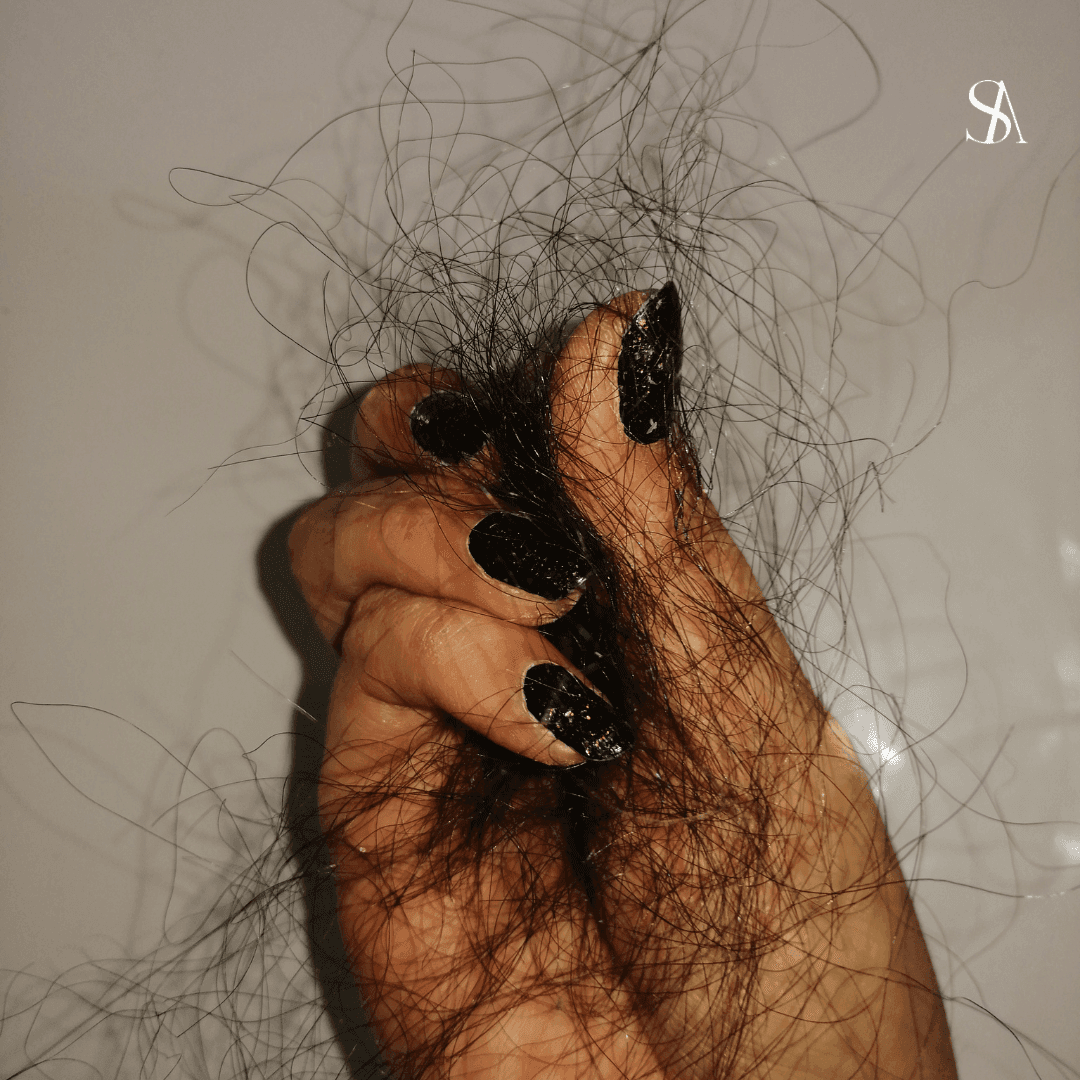
There is something almost absurd about the way we have learned to count our own hair. Dermatologists generally consider losing around 50 to 100 hairs a day to be within the range of normal shedding, although there is no universal number that applies perfectly to everyone, which means that the strand you find wrapped around your finger in the shower is rarely cause for alarm on its own; the more meaningful clue is a change from what is normal for you, whether that means noticeably more hair collecting around the drain, a part that appears wider than it once did, or a ponytail that somehow seems thinner each time you wrap the elastic around it. The strange part is that women have been losing hair for as long as women have had hair, yet the conversation surrounding it has remained remarkably quiet, especially compared with the enormous cultural vocabulary we have developed around almost every other aspect of female beauty. We have spent decades learning how to discuss wrinkles, cellulite, acne, gray hair, stretch marks and even pores, while thinning hair was often relegated to a much smaller, more private category of beauty anxiety, something to camouflage with a different part, a volumizing product, extensions or a strategic hairstyle rather than something to investigate.
That silence is beginning to feel increasingly outdated. Hair loss is not some rare problem reserved for men or women well into old age; female-pattern hair loss alone is common, with research estimating that approximately 40 percent of women show signs of it by age 50, while women can also experience temporary shedding after childbirth, illness, major stress, significant weight changes and other physiological disruptions. What has changed over the last decade is not that women suddenly began losing their hair, but that we became much more willing to ask why. The question has moved from the beauty aisle into the dermatologist’s office, from whispered conversations between friends into social media feeds, and from the margins of haircare marketing into one of the industry’s fastest-growing areas of interest. In 2026, hair loss is no longer being treated solely as an unfortunate cosmetic problem to disguise; increasingly, it is being discussed as something that can reveal what is happening underneath the surface.
The Hair in the Shower Was Never the Whole Story
For a long time, the easiest way to think about hair loss was simply to notice the hair that had already fallen out. A few extra strands in the shower could make someone wonder whether something was wrong, while a handful caught in a brush might seem like evidence that the problem had appeared overnight. What dermatologists understood, however, was that the visible shedding was often the last part of a much longer process. Hair grows in cycles, moving through phases of growth, transition and rest, and when that cycle is disrupted, the change may not become obvious until months after whatever caused it has happened.
That helps explain one of the most confusing forms of shedding women experience: telogen effluvium. After a major physical or emotional stressor, more hairs than usual can enter the resting phase of the cycle, eventually leading to noticeable shedding. The trigger might be an illness, surgery, childbirth, significant weight loss or another period of physiological stress, but the hair does not necessarily respond immediately. A woman can feel completely recovered from whatever happened and then, months later, begin finding considerably more hair in her brush or shower. The delay can make the connection almost impossible to see without understanding how the hair cycle works.
Dermatologist Joshua Zeichner has emphasized the importance of separating temporary shedding from other forms of hair loss, particularly genetic hair loss, because the two can look similar to someone experiencing them but require very different ways of thinking about what happens next. “Hair loss” is not one diagnosis; it is an umbrella term covering a range of conditions, from temporary shedding to progressive thinning and forms of alopecia in which inflammation or scarring can permanently damage the follicle.
That distinction matters emotionally as much as medically. When hair begins changing, women are often looking at something that has been part of their appearance for decades, sometimes since childhood. Women increasingly began sharing personal accounts of hair loss publicly, describing the confusion and emotional disorientation that often accompanies noticing changes to something so closely tied to identity and self-image. Dermatologist Dendy Engelman has similarly discussed the emotional burden that can accompany hair loss, particularly because the change is visible and difficult to separate from a person’s sense of identity. The hair in the shower may be the thing that gets your attention, but it is rarely the whole story.
We Finally Learned That Hair Loss Has Different Faces
The cultural image of hair loss has historically been much easier to recognize in men. A receding hairline or a thinning crown has long been treated as familiar territory, while women with thinning hair have often been left wondering whether what they were seeing was simply normal aging, stress or something they had done wrong.
Female-pattern hair loss does not necessarily announce itself with a receding hairline. More often, the part gradually widens, density decreases around the crown and the individual hairs become finer over time. Genetics play an important role, but the condition exists on a spectrum, and the way it appears can vary considerably from one woman to another.
Then there are the forms of hair loss that follow entirely different patterns. Alopecia areata, for example, is an autoimmune condition that can cause distinct patches of hair loss. Telogen effluvium can produce diffuse shedding after a physiological disruption. Scarring alopecias are different again because inflammation can destroy the follicle and make the resulting hair loss permanent.
The scalp itself can sometimes offer clues. Persistent itching, redness, scaling, tenderness or scabbing should not simply be dismissed as evidence that someone needs a better shampoo. They can signal an underlying scalp disorder or inflammatory process that deserves medical attention. The more specific the description of the hair loss becomes, the more useful the conversation with a dermatologist can be.
That was one of the quiet but important changes of the last decade: women became less likely to talk about “losing hair” as though it were a single experience. They began asking whether they were shedding, thinning, breaking, developing patches or experiencing changes to the scalp itself. The vocabulary became more precise, and with that precision came the possibility of more appropriate treatment.
Then Pregnancy Changed the Conversation
Pregnancy offered another way for women to notice just how closely hair can follow changes in the body. During pregnancy, hormonal shifts can keep more hairs in the growth phase, which is one reason many women notice that their hair seems fuller or thicker. Then the baby arrives, hormone levels change again, and some of those hairs move into the resting phase.
The resulting postpartum shedding can be startling, particularly for someone who has just spent months watching her hair look unusually abundant. What feels like a sudden loss is often the hair cycle catching up with the hormonal transition that has already taken place. Social media helped make that experience more visible, as women began sharing photographs and stories of postpartum shedding that might once have been discussed only privately.
That visibility mattered because embarrassment can be one of the biggest barriers to seeking help. A 2021 Vogue report noted that roughly 40 percent of women experience some form of hair loss by age 50, while many women still do not seek treatment because they feel uncomfortable talking about it. Once women began seeing other women describe the same experience, the subject became less mysterious and, perhaps more importantly, less shameful.
Pregnancy also offered a useful reminder that hair changes are not always a sign that something is going wrong. Sometimes they are evidence that the body is moving through a normal physiological transition. The challenge is learning when a change is temporary and expected, and when it deserves a closer look.
The Scalp Became Part of the Beauty Conversation
As women became more interested in what was happening to their hair, attention began moving downward, from the strand itself to the scalp beneath it. The shift was easy to recognize in beauty marketing. Haircare increasingly began borrowing the language of skincare, with consumers encouraged to think about cleansing, hydration, buildup and the overall condition of the scalp rather than treating the scalp as little more than the place where shampoo happened to land.
Dermatologist Francesca Fusco had been discussing scalp health long before it became a beauty-industry trend, but the idea gained considerably more traction as hair loss became a mainstream subject. Suddenly, the scalp was no longer invisible. Products designed specifically for it began appearing alongside shampoos and conditioners, and consumers were encouraged to consider the environment around the follicle as part of their hair routine.
There is an important distinction, though, between caring for the scalp and treating hair loss. A healthy scalp may support healthy hair, but a scalp serum is not automatically a treatment for female-pattern hair loss, and a product that makes the hair feel cleaner or fuller is not necessarily changing the biology of the follicle. A 2023 review of female-pattern hair loss noted that many treatments still have limited evidence behind them, and researchers continue to work to understand the mechanisms involved in follicular miniaturization.
The change in language was nevertheless significant. Women were beginning to understand that the visible hair on their heads was connected to living tissue underneath it, and that treating the appearance of the hair and understanding the health of the follicle were not necessarily the same thing.
Black Women Became a Bigger Part of the Conversation
Any honest account of the way women’s hair-loss conversation has changed has to make room for the fact that women do not all experience hair loss in the same way. For Black women in particular, hair has never been simply hair. It can carry questions of beauty, identity, culture, professionalism and self-expression, while also reflecting generations of hairstyling traditions and practices that can place very different demands on the scalp and hair follicle. As hair loss became a more visible subject in dermatology and popular culture, those differences became harder to overlook.
Traction alopecia is one of the clearest examples. The condition can develop when repeated pulling or tension places stress on the hair follicles, and certain hairstyles can contribute to that tension over time. What makes the conversation more complicated is that the hairstyles themselves are often deeply meaningful. Braids, locs, extensions, weaves, wigs and other protective styles can be an important part of how a woman wears and understands her hair, which means that telling someone simply to stop wearing the styles she loves is not much of a solution. The more useful question is how tension, duration, chemical processing, scalp health and an individual’s own susceptibility come together over time.
There is another condition that has become increasingly important to recognize: central centrifugal cicatricial alopecia, or CCCA, a form of scarring hair loss that disproportionately affects Black women. It often begins near the center of the scalp and gradually expands outward, and unlike temporary shedding, scarring alopecia can permanently damage the follicles. That makes early recognition particularly important, because the goal is not only to encourage regrowth but, when possible, to prevent further follicular damage.
The growing attention to these conditions has helped move the conversation away from the old idea that hair loss simply means a woman has not been taking good enough care of her hair. Hair is affected by biology, genetics and styling practices, but it also exists within a person’s actual life, and that context matters when deciding what treatment should look like.
That philosophy is reflected in the work of dermatologist Chesahna Kindred and hair-loss specialist Susan Peterkin at Kindred Hair & Skin Center in Maryland, where medical treatment and salon care are integrated into the same conversation. Kindred has described successful hair-loss treatment as collaborative, involving medical professionals, stylists, and patients rather than positioning those perspectives against one another. The model recognizes something that medicine and the beauty industry have often treated as two separate issues: treating the follicle is only part of treating the person attached to it.
A dermatologist may be able to identify inflammation, scarring or follicular damage and recommend medical treatment, but that does not mean a woman suddenly stops caring about how she wears her hair. She still has a job, a wedding, a vacation, a morning routine, a relationship with her stylist and a sense of herself that may be closely tied to the way she looks. A realistic approach to hair loss has to account for all of that.
That is perhaps one of the most important changes in the conversation around Black women’s hair loss: the recognition that cultural practices and medical care do not have to be positioned against each other. The goal is not to tell women that the ways they have always worn their hair are inherently wrong, but to understand when certain practices may be contributing to damage, identify the warning signs earlier and give women enough information to make choices about their hair without having to choose between their identity and their health.
As the broader hair-loss conversation has become more sophisticated, that distinction matters. The question is no longer simply whether a woman can keep wearing the hairstyle she loves. It is whether she can keep wearing it in a way that respects the health of her scalp and follicles, and whether she has access to someone who understands both sides of that equation.
The Ingredient Era Arrived
Once women started talking more openly about hair loss, the beauty industry was quick to respond. What had once been a relatively quiet concern became a major category of haircare, complete with scalp serums, supplements, oils, devices and increasingly elaborate routines promising to help women hold on to the hair they had or encourage more of it to grow. The appeal was obvious. If a woman had spent years worrying that her hair was becoming thinner, the possibility of doing something about it was naturally more attractive than simply learning how to disguise the difference.
The language surrounding hair growth began to resemble the language of skincare. Consumers were encouraged to think about their scalps as they thought about their faces, paying attention to dryness, irritation and buildup while looking for ingredients that might support healthier-looking hair. Peptides, caffeine, botanical extracts, rosemary oil, supplements and red-light devices all entered the conversation, and social media made it easier than ever for women to encounter products through personal recommendations and before-and-after photographs.
But a photograph can show that someone’s hair looks different without proving why it looks different, or whether the product being advertised was responsible. That distinction matters because hair growth is an unusually emotional beauty promise. When someone buys a moisturizer, she may be hoping her skin will look smoother or brighter. When she buys a hair-growth product, she may be hoping to recover something she feels she is losing. Words such as “density,” “thicker,” “fuller” and “growth” therefore carry a particular weight, especially for a woman who has begun noticing more scalp through her part or more hair gathering around the drain.
Minoxidil stands apart from much of the crowded hair-growth market because it has decades of evidence behind it and remains one of the better-supported treatments for female-pattern hair loss. Even so, it is not the straightforward solution a beauty advertisement might suggest. It does not work for everyone, continued use is generally necessary to maintain its benefits, and some women experience side effects such as scalp irritation or unwanted facial hair growth. A 2023 review found that roughly 40 percent of patients may not show improvement with topical minoxidil, a reminder that even one of the most established treatments cannot promise universal regrowth.
The rest of the market is considerably harder to navigate. Some newer ingredients and technologies have promising research behind them, while others have far less evidence than their marketing suggests. A consumer scrolling through social media can encounter a dermatologist explaining female-pattern hair loss, a woman describing what worked for her and a company selling a scalp serum within the same few minutes, and the format can make all three appear equally authoritative.
At the same time, the business surrounding hair loss has grown rapidly. Minoxidil remains one of the most extensively studied treatments available for female-pattern hair loss and continues to occupy a unique position within a market increasingly crowded with products promising growth, density, and scalp support. Even so, treatment outcomes remain variable, and researchers continue emphasizing that no single intervention works equally well for every patient (Ramos et al., 2023). Hair loss was no longer being marketed only as something to address once it became obvious; increasingly, consumers were being encouraged to think about preserving density before they noticed a problem at all.
That may be one of the clearest changes in haircare over the last decade. Women are no longer being told simply to make thinning hair look fuller. They are being encouraged to think about the scalp, the follicle and the possibility of protecting what they have. But that shift also raised a more interesting question, one that the beauty industry could not answer with another serum: what if the hair was responding not just to what was being put on it, but to what was happening elsewhere in the body?
Then We Started Looking Beyond the Hair
For years, it was easy to think about hair as its own little beauty department. There was the shampoo, the conditioner, the styling products and, if something went wrong, perhaps a new haircut or a trip to the salon. The more women learned about hair loss, however, the harder that separation became to maintain. Hair does not exist independently of the rest of the body, and changes in it can sometimes accompany pregnancy, illness, significant weight loss, hormonal shifts, medication or other periods of physical stress.
That connection is particularly important because the timing can be misleading. A physiological disruption can occur months before the resulting shedding becomes noticeable, leaving a woman to search for an explanation long after the original event has passed. By the time she sees the change in her ponytail or notices more hair in the shower, the trigger may already feel like ancient history.
The conversation around GLP-1 medications has made that connection especially visible. As these drugs have changed the way people think about weight and metabolic health, hair shedding has become part of the discussion too, particularly among people who experience substantial or rapid weight loss. Dermatologists have suggested that, in some cases, the shedding may be related to the physiological stress of significant weight reduction and the resulting disruption of the normal hair cycle rather than the medication directly damaging the follicle. Once again, the hair may be reacting to a change in the body on a delay.
That delayed response is part of what makes hair so difficult to read. A pregnancy can be over before postpartum shedding begins. An illness can become a distant memory before the hair cycle catches up. A stressful period can end before a woman realizes that her ponytail has become thinner. The visible change can feel sudden even when the biology behind it has been unfolding for months.
We are also much better at noticing those changes than we used to be. There are photographs of us from almost every angle now, taken in bathroom mirrors, on vacation, during video calls and in ordinary moments when nobody intended to document anything. A widening part that might once have gone unnoticed can appear repeatedly in photographs, making gradual changes easier to recognize. That can be useful when someone is trying to determine whether her hair really has changed, but it can also make appearance anxiety harder to escape, especially when the same platforms are filled with extraordinarily thick hair and products promising dramatic transformation.
This is where the modern hair-loss conversation becomes complicated. Social media has made women more comfortable discussing something that was once embarrassing, but it has also created a space where medical information, personal experience and advertising sit almost directly beside one another. A woman looking for answers can find a dermatologist explaining a condition, another woman describing what worked for her and a company selling a product for the same problem, all within the same scroll. The information is more accessible than it has ever been, but so are the exaggerated promises.
And despite everything we have learned, there is still a great deal we do not know. Female-pattern hair loss remains difficult to treat for many women, researchers are still working to understand the mechanisms behind follicular miniaturization, and many newer treatments have not yet been studied through the kind of long-term, rigorous research needed to determine how consistently they work. Even treatments with substantial evidence behind them have limitations, which can be easy to forget when months of treatment are compressed into a thirty-second before-and-after video.
What has changed is not that we suddenly have all the answers. It is that women have a much better vocabulary for asking the questions. A woman can recognize the difference between temporary shedding and progressive thinning. She can notice that a widening part may be worth discussing with a dermatologist rather than automatically blaming stress or buying another shampoo. She can ask whether a treatment has evidence behind it, whether a hairstyle may be placing repeated tension on the follicle, and whether something that happened months earlier could help explain what she is seeing now.
That is a very different place from where the conversation stood ten years ago. Hair loss is still frustrating, sometimes frightening and, for many women, deeply personal. There will be new medications, technologies, ingredients and treatments in the years ahead, and some will undoubtedly prove more useful than others. But perhaps the more meaningful change is that women are no longer expected to treat thinning hair as an embarrassing secret that should be hidden until it becomes impossible to ignore.
The hair was always telling us something. We are simply getting better at listening.