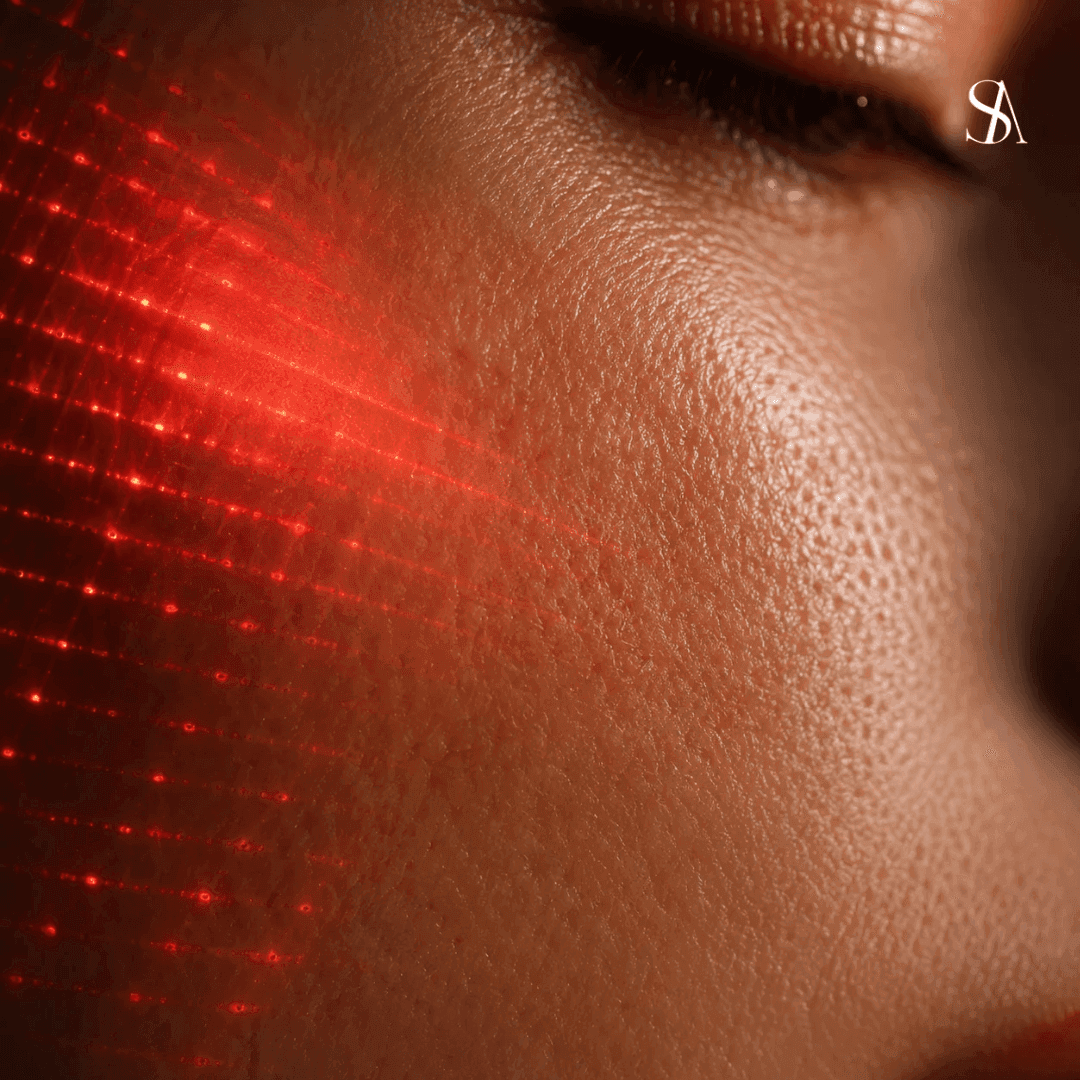
The technology that once promised to erase our skin is becoming something much more precise: a way of understanding, repairing, and remodeling it.
There is something almost wonderfully strange about the fact that one of the most sophisticated tools in modern dermatology is, at its most basic level, a beam of light. Depending on its wavelength, intensity, and depth of treatment, that concentrated energy can target pigment, blood vessels, hair follicles, acne scars, sun damage, and the deeper structures responsible for collagen production. Today, laser treatments can be customized to address concerns that look remarkably similar on the surface but may require entirely different approaches beneath it. Ten years ago, however, lasers still carried an intimidating reputation, bringing to mind peeling skin, weeks of recovery, dramatic before-and-after photographs, and the promise of leaving a dermatologist’s office with what looked like an entirely new face.
The technology was already remarkably advanced by 2015, but dermatology was still exploring how to make treatments more precise, customizable, and appropriate for different skin types. Fractional resurfacing was among the developments changing the field, helping reduce some of the recovery associated with older, fully ablative approaches (Carniol et al. 2015). What has happened since is less a story of one miraculous new machine replacing an old one and more a story about dermatologists becoming increasingly sophisticated about what they are actually trying to change beneath the surface, a shift that has transformed both the science of skin rejuvenation and the way we think about the treatments themselves.
When Lasers Became More Than Resurfacing
For years, laser resurfacing was largely understood through the idea of removal: skin had been damaged by the sun, marked by acne, lined by time, or left uneven in texture and tone, and the solution was to remove damaged layers so healthier-looking skin could emerge. Ablative carbon dioxide and Er:YAG lasers became powerful tools for this kind of resurfacing, but the results could come with significant redness, swelling, discomfort, prolonged healing, and risks that included infection, scarring, and changes in pigmentation. The technology could deliver impressive results, but the recovery was not always something patients could easily fit into everyday life.
Fractional laser technology helped change that equation. Rather than treating every millimeter of skin in the same way, fractional devices create microscopic columns of controlled injury while leaving surrounding tissue intact, allowing the skin to repair itself more efficiently. Physicians can adjust the treatment according to factors such as energy, depth, and the density of those microscopic treatment zones, making it possible to tailor the procedure to the concern being addressed (Carniol et al. 2015). The result was not simply a gentler laser, but a more adaptable approach to resurfacing.
That distinction matters because a laser does not work the same way on every part of the skin. Depending on the technology, it may remove portions of the skin’s outer layer, heat deeper tissue without removing the surface, or selectively interact with pigment and blood vessels. A review published in the Journal of Cosmetic Dermatology in 2024 described the expanding range of ablative, non-ablative, fractional, hybrid, and picosecond technologies, each offering different mechanisms and treatment goals, while highlighting how advances in device design and knowledge of skin physiology have made treatments increasingly customizable (Haykal et al. 2024).
This is one of the biggest things to understand about modern laser treatments: a laser is not one procedure. When someone says they are getting “a laser,” they are describing a category of technology so broad that the phrase means very little without knowing what device is being used, which concern it is meant to address, and how the treatment will interact with their skin. A laser designed to target pigment does not work in the same way as one intended to stimulate collagen, and a vascular laser used to address redness is not interchangeable with a resurfacing laser used for acne scars.
The names of the machines have become beauty-industry shorthand, with Fraxel, CO₂, Er:YAG, Nd:YAG, pulsed dye, picosecond lasers, and intense pulsed light, commonly known as IPL, often discussed as though they were variations of the same treatment. They are not. Different wavelengths interact with different targets in the skin, whether that means melanin responsible for dark spots, hemoglobin associated with visible blood vessels, or water found throughout our tissue. Once the light is absorbed, it creates a particular reaction, allowing dermatologists to target a concern while trying to limit unnecessary damage to the surrounding area (Reynal et al. 2023). In practical terms, the machine matters, but so does the person operating it, the settings selected, and the skin receiving the treatment.
The Skin-Color Conversation We Should Have Been Having Earlier
One of the most consequential developments in laser dermatology has been the growing recognition that a procedure cannot be considered genuinely advanced if it only works predictably on a narrow range of skin tones. Melanin absorbs light, which is precisely why certain lasers can be useful for treating pigmentation, but it is also why treatment becomes more complicated in skin containing greater amounts of melanin. If the laser’s energy is absorbed by pigment that was not intended to be the target, the resulting heat can contribute to burns, inflammation, post-inflammatory hyperpigmentation, hypopigmentation, or scarring. For years, these risks meant that some resurfacing procedures were approached much more cautiously, or avoided altogether, in patients with darker skin.
The field has made meaningful progress, although the risks have not disappeared. A 2017 evidence-based review by dermatologists Shivani B. Kaushik and Andrew F. Alexis found that non-ablative fractional lasers could be useful for several concerns in darker skin types, including acne, acne scarring, stretch marks, melasma, and skin rejuvenation. The authors also emphasized that high-quality evidence was limited for the darkest skin types, highlighting a gap that cannot be solved simply by developing more advanced devices (Kaushik and Alexis 2017). A later review published in Dermatologic Surgery in 2024 examined research on non-ablative fractional lasers in darker skin phototypes and likewise emphasized the importance of choosing appropriate technologies and treatment parameters for individual patients (Aggarwal et al. 2024). Melasma also deserves particular caution: even when treatment initially improves discoloration, it can recur, and some energy-based procedures may trigger additional pigmentation or worsen the condition, making ongoing maintenance and careful patient selection important (Reynal et al. 2023).
For anyone whose skin has ever darkened after a pimple, insect bite, burn, or scrape, this distinction is not merely technical; it is the difference between treating discoloration and potentially creating more of it. Two people seeking treatment for similar acne scars, for example, may need different devices or settings because their skin responds differently to inflammation and thermal injury. A responsible treatment plan therefore considers not only what someone wants to improve but also their skin tone, history of pigmentation, tendency to scar, and tolerance for recovery.
This is also why choosing a qualified professional matters more than choosing a treatment based on its popularity online. The Mayo Clinic warns that laser resurfacing can cause treated skin to become darker or lighter than it was before, and that people with brown or Black skin face a greater risk of long-term changes in skin color. It recommends seeking a clinician experienced in selecting appropriate lasers and settings for a range of skin tones (Mayo Clinic). Technology has expanded the possibilities, but it has not made every procedure appropriate for every person.
From Removing Damage to Remodeling Skin
As laser technology has evolved, so has the beauty industry’s understanding of what it means to improve skin. For years, the conversation centered on polishing, exfoliating, brightening, covering, or resurfacing the visible surface, while dermatology increasingly explored the deeper structures responsible for the way skin looks and behaves. Collagen became one of the industry’s favorite words, appearing everywhere from skincare packaging to cosmetic consultations, but the science behind collagen stimulation is more complicated than the promise of simply producing more of it.
Collagen is part of a constantly changing network within the skin that responds to injury, inflammation, aging, ultraviolet radiation, and other biological processes. Certain lasers can encourage remodeling by delivering controlled thermal injury that activates the body’s wound-healing response and changes collagen organization over time (Haykal et al. 2024). The effects are not necessarily immediate, which helps explain why someone undergoing non-ablative resurfacing may need several sessions to see gradual improvements in texture and tone rather than leaving the clinic with a dramatic transformation (Mayo Clinic).
This gradual approach fits neatly into the wider beauty conversation, where the focus has increasingly shifted toward skin quality: how smooth, even, luminous, or healthy the skin appears, rather than whether someone looks visibly different. Retinoids, microneedling, LED devices, peptides, and professional laser treatments all occupy different places within this broader interest in improving the skin itself instead of relying exclusively on makeup or other ways of concealing its appearance. Yet the science behind each treatment is different, and the language of collagen can make procedures sound more interchangeable than they really are.
Lasers are not simply a more powerful version of a serum, nor does stimulating collagen guarantee that every concern will improve. The outcome depends on the condition being treated, the device, the treatment plan, and the individual’s response, which is why a consultation should begin with an assessment of the skin rather than a particular machine or trend.
Why Laser Treatments Feel Different Now
There is another reason lasers have become such a visible part of contemporary beauty culture: aesthetic procedures are increasingly discussed as maintenance rather than as dramatic transformations reserved for a particular stage of life. People may seek treatment for a few lingering acne scars, uneven pigmentation, or texture that makeup does not completely conceal, rather than because they want to change the overall shape of their face. Treatments are also frequently discussed alongside other approaches to skin rejuvenation, including injectables, prescription skincare, and procedures designed to address different aspects of aging.
The numbers reflect how firmly aesthetic treatments have entered mainstream medicine, although they do not tell the whole story of why people choose them. According to the American Society of Plastic Surgeons’ 2024 procedural statistics, 3,703,305 skin-resurfacing procedures were reported in the United States, a category that includes dermabrasion, chemical peels, microdermabrasion, and ablative and non-ablative lasers. Another 3,112,056 skin-treatment procedures were reported, including laser hair removal, IPL, tattoo removal, and laser treatment for leg veins (American Society of Plastic Surgeons). These figures cover multiple treatments rather than laser resurfacing alone, but they offer a sense of how familiar energy-based procedures have become within aesthetic medicine.
The cultural shift is perhaps most apparent in the growing preference for results that are difficult to identify as the work of a procedure. Rather than aiming to look dramatically altered, many people describe wanting smoother texture, a more even complexion, or skin that looks healthy without appearing heavily treated. That desire has created an interesting contradiction: achieving an apparently effortless face can involve an extraordinary amount of technology, from carefully selected laser treatments to elaborate skincare routines and professional maintenance.
The pressure behind that ideal becomes particularly interesting in the age of TikTok and Instagram, where filters can erase pores, soften pigmentation, blur texture, and create an almost impossible uniformity across the skin. Real skin does not behave like an edited photograph, and lasers cannot reproduce that digital effect. Pores, fine lines, scars, hair follicles, visible blood vessels, and variations in pigment are all normal features of living skin, even when social media encourages us to view them as imperfections requiring correction.
A well-chosen laser treatment may make acne scars less noticeable, soften the appearance of sun damage, or improve uneven texture without fundamentally changing the way someone looks, but it cannot promise the poreless, perfectly uniform skin that filters create. The most interesting question is therefore not whether technology can make skin look flawless, but how we decide what improvement should look like in the first place. When every mark becomes something to treat and every pore becomes something to blur, even a useful dermatological procedure can become part of an endless attempt to achieve an image that real skin was never designed to reproduce.
These differences matter when expectations are shaped by social media, where a treatment may be presented through a few satisfying before-and-after photographs without much discussion of preparation, recovery, cost, or possible complications. A photograph cannot tell you whether the patient needed one session or several, whether the results lasted, whether the treatment was appropriate for a different skin tone, or how much healing occurred outside the frame. Nor does a popular treatment automatically become the best choice for someone with a different concern.
Better Technology Does Not Mean Risk-Free
The temptation with any technological story is to assume that newer automatically means safer, and laser dermatology is no exception. Modern fractional and non-ablative systems have expanded the range of available treatments and can reduce downtime compared with some older resurfacing procedures, but laser treatments still carry risks that include burns, infection, scarring, and changes in pigmentation. Recovery also varies according to the procedure: a treatment that heats deeper tissue without removing the skin’s surface may involve less downtime than an ablative procedure that removes layers of tissue. Treatment may also need to be postponed or modified in the presence of a recent course of isotretinoin, an active skin infection, or a tan at the time of the procedure; a history of keloid scarring may affect suitability, and people with a history of herpes simplex may need antiviral prophylaxis. These factors should be reviewed with a qualified clinician, particularly because people with darker skin tones may face a greater risk of pigmentary changes.
The future of laser dermatology may therefore depend less on finding the strongest treatment available and more on determining which wavelength, energy level, and approach are appropriate for one particular person’s skin, including when a less aggressive treatment is likely to produce a better outcome. Progress is not simply a matter of doing more to the skin; it is also about understanding when to do less, how to minimize unnecessary injury, and how to set realistic expectations about what a procedure can accomplish.
What We Know Now
For decades, beauty promised new skin through creams, acids, peels, surgery, and increasingly sophisticated technology, while modern dermatology has moved toward a more nuanced question: how can we encourage the skin to repair and remodel itself without causing more injury than necessary? Researchers continue to refine wavelengths, delivery systems, and treatment protocols, and important questions remain about long-term outcomes and the best approaches for different skin tones. Yet the direction of the field reflects a more individualized understanding of skin as a living, responsive organ rather than a surface that can simply be polished into perfection.
Perhaps what we were missing ten years ago was the realization that treating skin is not about making it disappear and starting over but about understanding the extraordinarily complicated organ we already have. Technology can help skin look and function at its best, but only when we understand what it can and cannot do.