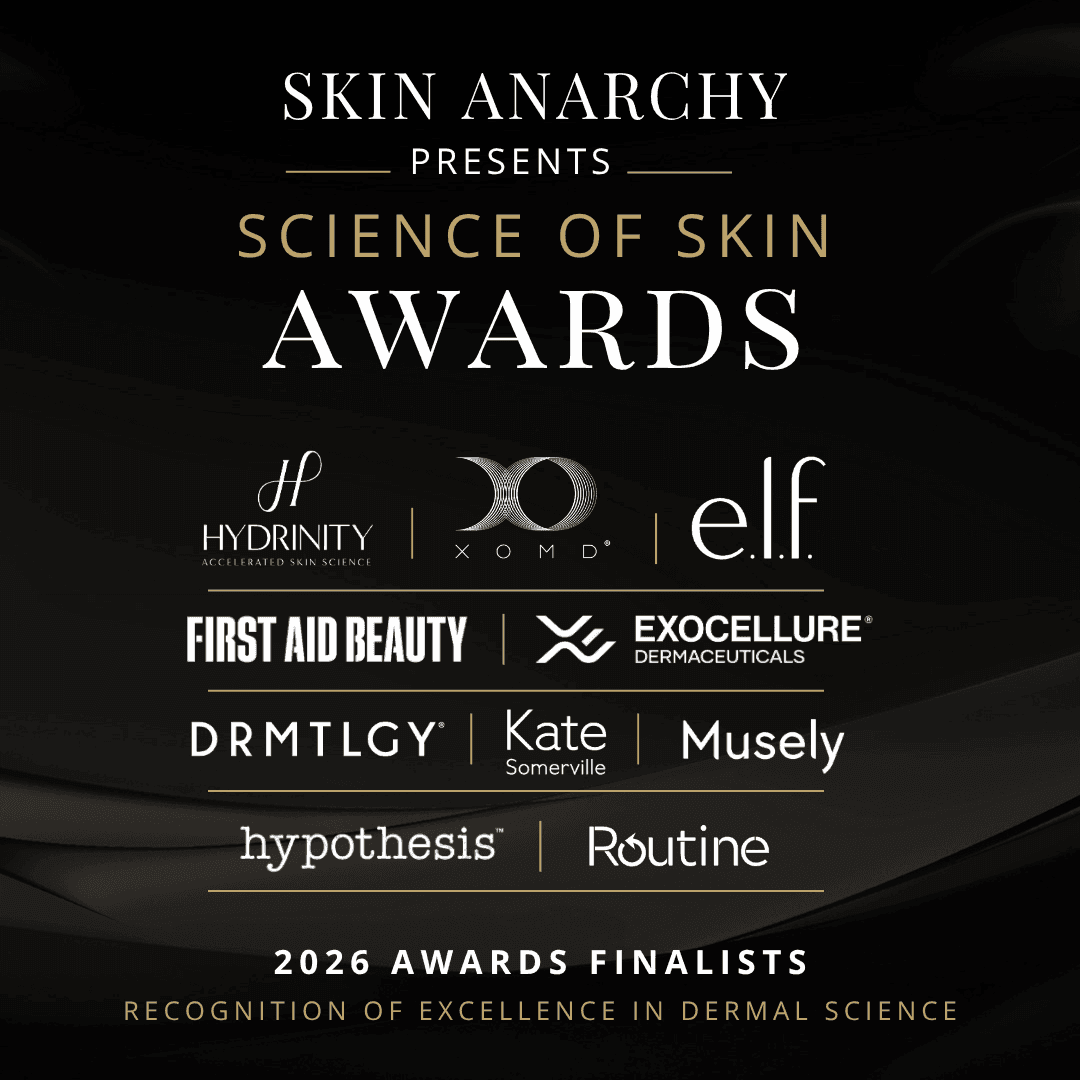
The 2026 Science of Skin Awards recognize ten brands whose products meet a standard of scientific validity that goes beyond marketing language. In this solo episode, Skin Anarchy host Dr. Ekta Yadav walks through every winner, from e.l.f. Beauty at enterprise scale to exosome characterization data, microbiome biotechnology, peptide manufacturing, teledermatology, and a brand new category built on oxytocin signaling. Below is the full breakdown of who won, what earned each brand recognition, and what the selections say about where skin science is heading.
Congratulations to all the winners: e.l.f. beauty, Exocellure Dermaceuticals, First Aid Beauty, Hydrinity, Hypothesis, DRMTLGY, XOMD, Musely, Kate Somerville, and Routine Skin
What are the Science of Skin Awards?
The Science of Skin Awards are an annual recognition program from Skin Anarchy that honors ten skincare brands per year for scientific validity and demonstrated efficacy rather than trend visibility. The program exists to give consumers a reliable signal in a category where claims often outpace evidence, and as the host explains, “these awards are incredibly meaningful to us here at Skin Anarchy because for us they represent something that is very much needed in a very overcrowded space such as skin care.” Selection weighs formulation logic, mechanism, and whether a brand can prove that its products do what the label says.
Who won the 2026 Science of Skin Awards?
The 2026 Science of Skin Award winners are e.l.f. Beauty, Exocellure Dermaceuticals, First Aid Beauty, Hydrinity, Hypothesis Bio, DRMTLGY, XOMD, Musely, Kate Somerville, and Routine Skin. The list spans mass market accessibility, regenerative science, microbiome biotechnology, professional grade formulation, teledermatology, and peptide manufacturing. What connects them is a shared refusal to treat novelty as a substitute for evidence, or as the episode puts it, brands “representing a multitude of different characteristics that I think are incredibly important” to an industry trying to close the gap between consumer care and dermatological rigor.
Why did e.l.f. Beauty win a Science of Skin Award at enterprise scale?
e.l.f. Beauty won on an enterprise scale for delivering clinically meaningful formulations at accessible price points with unusual consistency across a large portfolio. “I have never seen a company of this scale do this so consistently,” the host says, pointing to a portfolio strategy where skin health precedes marketing narrative. The recognition acknowledges something structurally difficult: maintaining formulation discipline while operating at mass volume in a saturated market.
Which e.l.f. Beauty brands are worth turning to for proven skincare actives?
RODE, Well People, Naturium, and e.l.f. SKIN are the portfolio brands called out for reliable access to well formulated actives. Whether the need is an encapsulated retinoid, hyaluronic acid, a peptide serum, or azelaic acid, “all of these brands are something you can come to every time you don’t know what to buy,” the host says. The through line is dependability on the tried and true actives rather than a rotating cast of novel ingredients.
How do you know if an exosome skincare product actually contains exosomes?
You verify it through characterization data, specifically surface markers such as CD81 that confirm the particles are genuine vesicles rather than cellular debris. Exocellure Dermaceuticals supplied exactly that when asked, and the host is explicit about the request: “I asked them straight up for all of their data around characterization and they were able to provide very compelling evidence.” In a category where the word exosome appears on labels far more often than the data supporting it does, characterization is the dividing line between a regenerative product and a marketing claim.
Why do exosomes lose bioactivity at room temperature?
Exosomes degrade because the vesicle membrane is held together by surface tension that relaxes once the particle thaws, releasing the cargo that gives the product its activity. Anyone working in aesthetics has run into this, and as the host notes, “you know that exosomes lose their bioactivity when they are thawed and especially when they are sitting at room temperature.” Exocellure addresses it by encapsulating individual particles, which is what makes room temperature shelf stability possible and what allows the brand to build its professional and post treatment protocols on consistent dosing.
What made First Aid Beauty a pioneer in skin barrier care?
First Aid Beauty built barrier repair into a functional product category years before barrier health became a mainstream conversation. The brand was serving compromised, eczema prone, and rosacea prone skin when few others were, and as the host puts it, “they were one of the first to actually put barrier health front and center in the skincare space.” That early positioning is now the industry standard, which is precisely the case for recognizing it.
What does colloidal oatmeal do for compromised skin?
Colloidal oatmeal calms irritation and supports barrier function, and newer research points to benefits well past simple soothing. It appears across the First Aid Beauty lineup at 0.5%, and the host notes that “now we are learning how much benefit there is to using colloidal oatmeal beyond just reducing irritation or reducing… sensitivity.” For skin that is reactive, inflamed, or recovering, it remains one of the most quietly evidence backed ingredients in the category.
How is Hydrinity rethinking hyaluronic acid beyond hydration?
Hydrinity treats hyaluronic acid as a repair signal rather than a surface hydrator, building technologies around how it supports recovery, barrier function, and tissue repair. That framing is why the brand became a favorite for post procedure protocols among aesthetic providers. As the host describes it, Hydrinity “first established itself by rethinking one of skincare’s most familiar ingredients, which was hyaluronic acid,” a reframe that turned a commodity molecule into a functional one.
What is Hydrinity RetaXome and why does delivery science matter?
RetaXome pairs retinaldehyde with a biomimetic exosome delivery system designed to improve stability, penetration, and tolerability, three variables that determine whether a retinoid performs as intended. Delivery has become the limiting factor as the market shifts toward regenerative actives, and the host is direct about it: “when you look at ingredients like that, you cannot leave delivery science behind.” Formulation vehicles have to evolve in parallel with the molecules they carry, or the biology never reaches the target.
What is precision microbiome engineering in skincare?
Precision microbiome engineering means selectively removing disease associated microbes while leaving the skin’s beneficial flora intact, in contrast to broad spectrum antimicrobials that strip everything. Hypothesis Bio was, in the host’s words, “founded on the belief that the future of dermatology lies in precision microbiome engineering,” and built patented enzyme technologies to execute it. The approach reframes microbiome care as a targeting problem rather than a probiotic marketing angle.
How do bioengineered enzymes target acne and eczema bacteria?
Bioengineered enzymes work by recognizing specific microbial targets, which allows a formula to act on one problem organism without collapsing the surrounding ecosystem. Hypothesis Bio’s eczema and acne products are built on exactly this logic, with the host explaining that “they’re both utilizing independent bioengineered enzymes that will specifically go and target microbes such as Staph aureus or C. acnes, respectively.” What makes it notable is the translation itself, since this class of academic research rarely survives the trip from lab bench to at home product.
Why did DRMTLGY win a Science of Skin Award?
DRMTLGY won for taking formulations developed over decades for dermatologists and plastic surgeons and making them available directly to consumers. “They were formulating for dermatologists, for plastic surgeons, for decades,” the host explains, before the founders recognized that patients loved the products but could not buy them independently. The Needleless collection reflects the same discipline, targeting collagen production and extracellular matrix health rather than chasing whatever ingredient is trending that month.
What are moodceuticals and how does XOMD OX Factor™ technology work?
Moodceuticals are a new product category built on the premise that skin health and emotional state are biologically linked, not just correlated. XOMD, founded by facial plastic surgeon Dr. Steven Dayan and dermatologist Dr. Sabrina Fabi, grounds the concept in oxytocin research and its patent pending OX Factor technology, positioning the brand at the front of an emerging psychodermatology category. The founders recognized that “the effects of healthy skin extend way beyond what we see in the mirror,” and built a formulation approach around a signaling pathway the category had largely ignored.
How does Musely make prescription strength dermatology more accessible?
Musely uses telemedicine and physician guided treatment plans to deliver customized prescription formulations for melasma, acne, hair loss, rosacea, and photoaging without an in office visit. Its formulas combine clinically established agents such as hydroquinone, tretinoin, tranexamic acid, and azelaic acid, selected for the individual patient and paired with ongoing physician oversight. That continuity matters enormously, because as the host puts it, “there are so many people right now that just simply do not have access to dermatological care,” whether they live in a rural community or face appointment waits measured in months.
What made Kate Somerville ExfoliKate a turning point in exfoliation?
ExfoliKate popularized multimodal exfoliation by combining alpha hydroxy acids, beta hydroxy acids, fruit enzymes, and physical polishing agents in a single treatment. The host calls it a product that “was a game changer in the industry,” and credits the brand’s esthetician origins for that practical, results first formulation instinct. Kate Somerville’s lineup keeps returning to the same principle, that knowing when and how to use an ingredient matters as much as the ingredient itself.
Why is GHK-Cu trending for the wrong reasons?
GHK-Cu is trending on ingredient recognition rather than formulation quality, and most products using it are not dosed at concentrations capable of driving the repair biology the peptide is known for. Routine Skin comes out of peptide manufacturing rather than ingredient sourcing, which is the distinction the host emphasizes: “they’re not buying their peptides from other companies and hoping that it just works.” Getting concentration and sequence right matters beyond one brand, because consumers who see nothing happen stop believing the category can work at all.
Listen to the full 2026 Science of Skin Awards episode on the Skin Anarchy podcast, available on Apple Podcasts, Spotify, and wherever you get your shows.