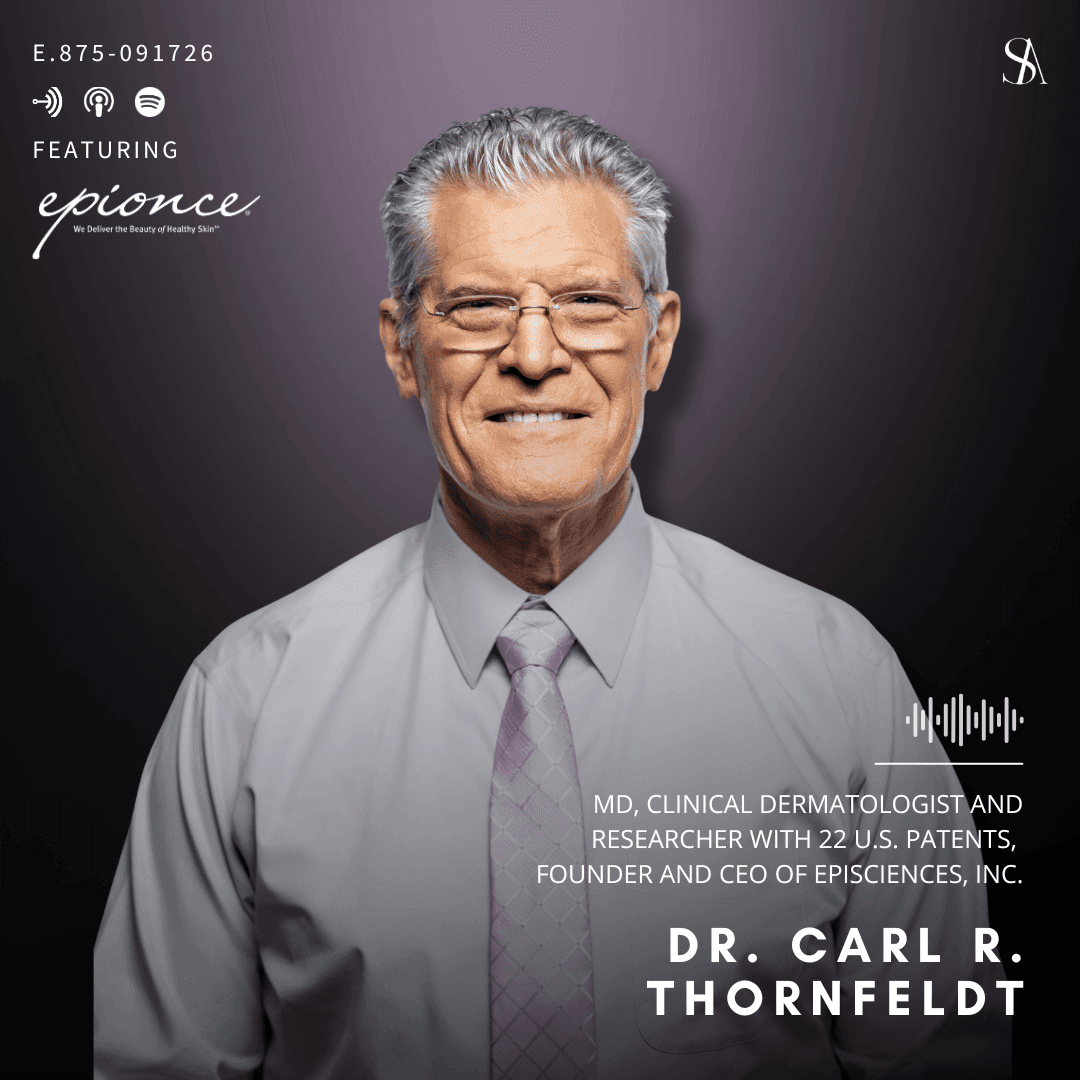
Dermatologist Dr. Carl Thornfeldt, founder of Epionce and holder of 22 patents, joins Skin Anarchy to explain the science of barrier repair before it was a trend: the discovery of the skin barrier ratio, why ceramides alone fall short, and why high dose actives can do more harm than good.
Who is Dr. Carl Thornfeldt?
A dermatologist whose childhood eczema drove a lifelong quest to understand skin. As the only full time dermatologist across 30,000 square miles of rural Oregon, he saw skin pushed to extremes and realized most treatments failed. "I wanted to completely get clear and stay clear and not have recurrence," which set him on a nine year study of how the epidermis regulates itself.
Why is the skin barrier so important?
Because the stratum corneum is a regulatory tissue, not just dead cells. Thornfeldt's team found that disrupting the barrier triggers repair signaling within minutes. "When the skin was injured for any cause... that would trigger synthesis of cholesterol, a number of the ceramides, and certain free fatty acids." A damaged barrier, he showed, is the root trigger of the chronic inflammation now called inflammaging.
What is the 3 to 1 to 1 barrier repair ratio?
The gold standard for rebuilding skin. Thornfeldt found that a specific ratio of cholesterol, ceramides, and free fatty acids, with half the fatty acids as linoleic acid, dramatically accelerates repair. "The three to one to one ratio triggered a dramatic epidermal proliferation," producing a new barrier in about three days instead of 28. A two to one to one ratio is 40 percent less effective.
Why does linoleic acid matter for skin?
Because the barrier cannot form properly without it. Replacing linoleic acid with other fatty acids left the barrier incomplete, partly because it is needed to build the right ceramides. "Linoleic acid was necessary for the optimum barrier function." It also calms inflammation and aids delivery, yet rarely appears on ingredient lists now.
Are ceramides alone enough to repair the barrier?
No, and this is the ceramide hero product fallacy. Used individually, each lipid actually disrupted the barrier more; only all three together enabled repair. "It wasn't until we had all three there that we could start seeing some benefit." Ceramides also work best at a pH of 4.5, low enough to sting many people.
What is the difference between moisturizing and barrier repair?
They are not the same. Hydration raises water holding capacity; barrier repair rebuilds the wall, and speed matters because an open barrier lets damage in. Thornfeldt's ratio achieved 89 percent barrier closure in 45 minutes, while petrolatum reached only 65 percent at eight hours. "You want to slam the barrier shut."
Is high dose vitamin C actually good for your skin?
Not necessarily, and it can irritate. Vitamin C needs iron and zinc to actually build collagen, so high concentrations alone often just cause inflammation that temporarily plumps skin. "No place in the body where a single antioxidant works." Several trials of high dose single antioxidants were halted early for increased disease.
Do retinoids work as well as they are marketed?
Only partly. Tretinoin acts on three of the skin's many pathways and is photosensitizing, and Thornfeldt watched it raise precancer rates in his own patients. "You've got 13 pathways that need to be modulated, and it works on three of them." That risk, he says, is why maintenance dosing exists.
Does bakuchiol actually work?
The evidence says no. Thornfeldt points to a Cochrane review of 15 trials that found no benefit. "Bakuchiol doesn't work," he says, calling it a marketing story built on poor quality studies.
Listen to the full episode with Dr. Carl Thornfeldt of Epionce on Skin Anarchy, available wherever you get your podcasts.