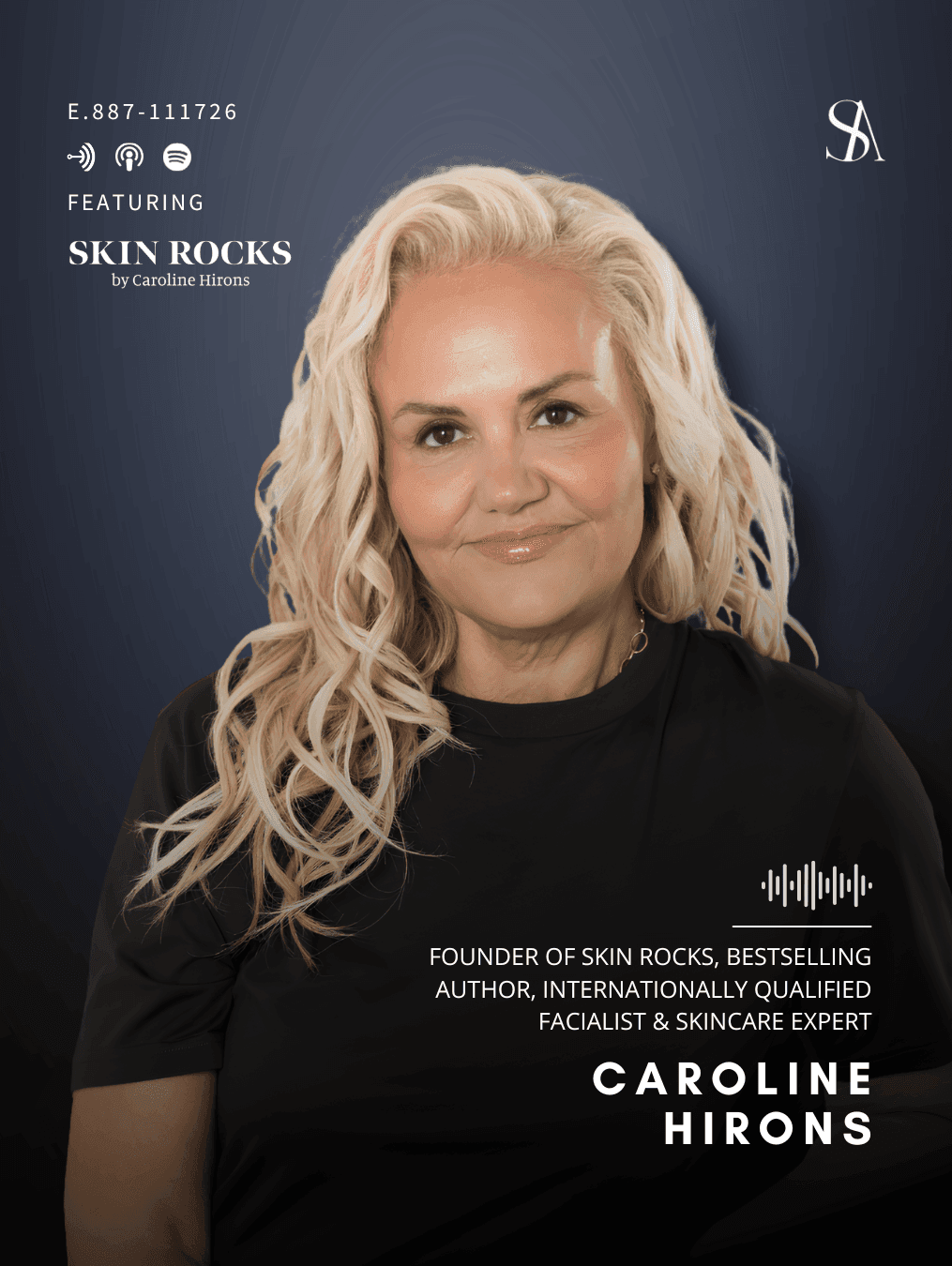
Skincare educator, bestselling author, and Skin Rocks founder Caroline Hirons joins Skin Anarchy to do what she does best: separate fact from marketing. She debunks "medical grade," explains the skin barrier, sets the record straight on retinoids and exfoliation, and defends the overlooked expertise of estheticians.
How did Caroline Hirons become a skincare authority?
Through decades on the shop floor, not social media. Raised by a trained mother, Hirons fell for skincare working the Aveda counter, then earned her esthetician qualification over several years while raising kids. "If I hadn't gotten a piece of paper, if I hadn't done that in depth training," she says, she would not have the career she has. She moved what she taught on the shop floor onto her blog.
Is "medical grade" skincare real?
No, it does not exist, Hirons says flatly. Medical grade means sterile surgical tools, not creams, and skincare is either a cosmetic or a drug. "If medical grade existed, my brand would be medical grade," she says, rejecting the claim that products penetrate the dermis, which she calls impossible without a needle.
Can skincare really penetrate the skin barrier?
Rarely, because the skin is a barrier, not a sponge. Hirons notes people repair their barrier in one breath and claim dermal penetration in the next. "If water penetrated, you wouldn't be able to take a bath," she says, explaining only molecules under 500 Daltons pass through, which is why nicotine patches work and most actives do not.
Are estheticians or dermatologists more qualified on skincare?
Each has a lane, and estheticians are underrated, Hirons argues. Dermatologists own skin disease and cosmetic scientists own formulation, but neither has hands on skin all day. "To rule out people's lived experience just for a qualification is a mistake," she says, noting the best skincare lines are often built by estheticians.
What actually keeps your skin barrier healthy?
Water and oil, in the right balance for your skin. Hirons strips it back to what skin is made of, warning against overdoing any one thing, and names the real secret as consistency. "A lot of people don't do it. They jump from one product to another," she says, instead of giving actives time to work.
How should you actually use retinoids?
Build up by strength and age, like yoga levels, Hirons says. She offers beginner, intermediate, and advanced retinoids and warns against pure retinoic acid used too aggressively. "There's only so many times your skin will turn over before you've just destroyed it," she says, avoiding cheap retinol for gentler forms like retinal and HPR.
Are Americans overdoing their skincare?
Yes, in two specific ways, Hirons says. From years of trainings, she sees US consumers overexfoliate and fear facial oils, neither of which happens in Europe. "You don't need to exfoliate your face every single day or twice a day. Leave something on the plate," she says, recommending gentle acid exfoliation two to three times a week.
What is vitamin C actually for?
Antioxidant protection, not fixing pigmentation, Hirons says. Brightening is a side effect, but its real job is defending skin against pollution and daily damage. "It's a nice side effect, but it's not what it's for," she says, which is why her formula is a boosted 5 percent, not a harsh 20 to 30 percent.
How do you build a skincare brand that lasts?
By solving real problems, not chasing profit, Hirons says. She resisted spinning out endless tied together products, building Skin Rocks around genuine needs like pigmentation, pores, and barrier repair. "If you are chasing profit for shareholders over the end result for your consumer, you will fall down," she says.
Listen to the full episode with Caroline Hirons on Skin Anarchy, available wherever you get your podcasts.