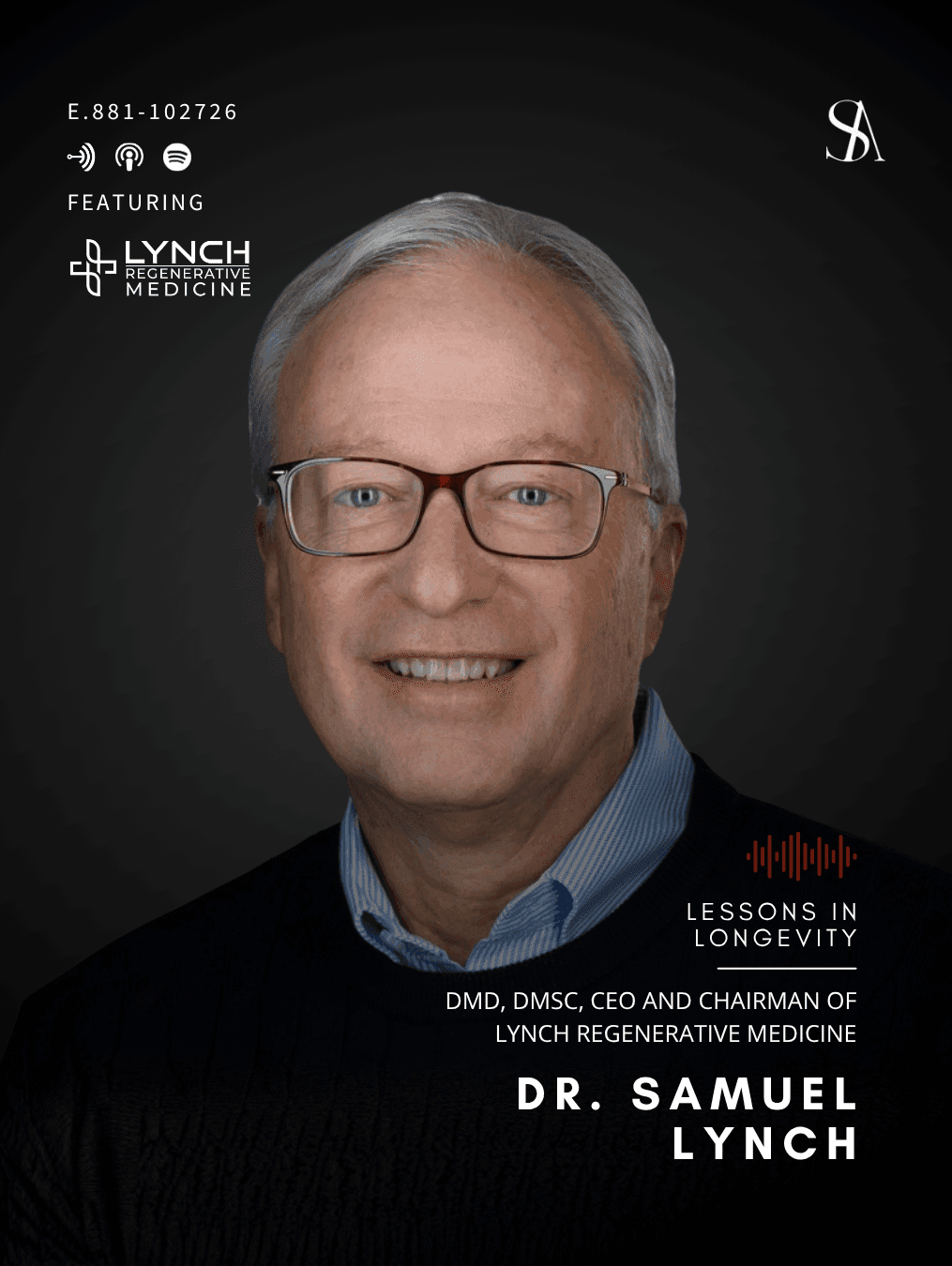
Dr. Samuel Lynch, who discovered how PDGF drives healing and turned it into FDA approved regenerative medicine, joins Skin Anarchy to separate real regenerative science from marketing: what PDGF actually does, why most growth factor products fall short, and the new under eye trial that could change aesthetics.
Who is Dr. Samuel Lynch?
A regenerative medicine pioneer who spent 35 years studying how the body heals. Working beside the American Red Cross, he isolated the protein in platelets that signals injury and triggers repair. "I spent my whole career trying to answer two very simple questions. One, how does a body know that it's been injured... and two, how does it stimulate the healing process?"
What is PDGF?
Platelet derived growth factor, the protein released from a blood clot that kickstarts healing. Lynch isolated it, mapped its gene, and produced it in yeast cells as pure recombinant human PDGF. "It remains the only growth factor to have ever gotten FDA approval for tissue regeneration," he says, after treating over five million patients in dental and bone medicine.
Why is PDGF so effective for regeneration?
Because it is both the most potent and the most balanced growth factor. Unlike actives that force one type of collagen, PDGF raises types one, three, and six collagen, elastin, and natural hyaluronic acid, plus blood supply. "It gives you a really nice, balanced rejuvenative and regenerative response," Lynch says, taking healing capacity from how it is at 50 back toward 18.
What makes PDGF-BB different from other forms?
It is the only form that activates both PDGF receptor types. Other isoforms each reach only one receptor, limiting the response. "PDGF-BB... is the only type of PDGF that stimulates both isoforms of receptors in your body," Lynch explains, producing its whole body, holistic effect.
Do the growth factors in exosomes and PDRN actually work?
Rarely at meaningful levels, according to Lynch. Many products claim growth factors, but the amounts are tiny and, in his view, subtherapeutic. "To detect a growth factor on a laboratory bench... is a night and day difference from using it therapeutically," he says, stressing medicine requires consistent, reproducible doses like insulin.
Do topical growth factor serums work on intact skin?
Mostly unproven, Lynch says. A serum may deliver a short glow, but lasting regeneration needs the growth factor to reach past the surface. "To get the longer lasting true tissue regeneration... you need to do something to disrupt the surface of the skin," whether microneedling, peels, or lasers, so the molecule can penetrate.
How does PDGF reduce downtime after microneedling or laser?
By speeding you through the inflammatory phase of healing. PDGF modulates inflammation and upregulates the body's other growth factors, moving skin faster to repair. "Your redness, your swelling, your pain, the heat... after a laser or a microneedling treatment is significantly reduced," Lynch says of topical PDGF after a procedure.
What is the PDGF under eye trial?
A Phase 2B FDA trial injecting pure PDGF for under eye hollowing, which Lynch reports is the first pure growth factor to reach this stage with FDA approval, a randomized controlled study in up to 75 patients. "The safety of this molecule has been established beyond any other growth factor, period," built on two decades of injection studies.
Why is under eye hollowing so hard to treat?
Because it is multifactorial, and existing options fall short. Fillers can migrate or cause vascular problems, and PRP and PRF have underwhelmed, which is why Lynch sees heavy off label PDGF use there. Most patients, he argues, "would rather have their own tissue regenerated than... a filler injected."
Listen to the full episode with Dr. Samuel Lynch on Skin Anarchy, available wherever you get your podcasts.