From the painted faces of the 1920s to the clean girl and the return of bold makeup, the history of cosmetics reveals something larger than changing trends: every generation reinvents the face
In the 1940s, American women were buying so much red lipstick that the cosmetic became intertwined with the visual language of patriotism, and during World War II, beauty companies marketed cosmetics as part of a woman’s contribution to maintaining morale while men were away fighting. By the end of the decade, an estimated 80 to 90 percent of American women were wearing lipstick, a statistic that says something much more interesting about beauty than simply how popular a particular shade happened to be: sometimes, what we put on our faces becomes a reflection of the world we are living in (Smithsonian Institution, 2026).
We tend to think of makeup as personal. It happens in front of a mirror, usually before anyone else sees us, and the decisions seem small enough to belong entirely to us. We choose whether we want lipstick or lip gloss, whether our skin should look dewy or matte, whether today calls for a little mascara or a full face, and in those moments it is easy to believe that our choices are expressions of individual taste. Yet there is something revealing about looking through an old photograph and realizing that the face staring back at you once felt completely normal. The eyebrows that now seem impossibly thin were, at the time, exactly how you wanted them. The brown lip liner that now feels unmistakably tied to another decade once seemed like the only way to wear lipstick. The heavy foundation, the particular placement of blush, the shape of the eyeliner, even the color of the eyeshadow all once felt less like a trend than simply the way a beautiful face was supposed to look.
That is the strange cultural power of makeup. We often talk about beauty trends as though they are superficial changes in color and technique, but the history of cosmetics reveals something much more complicated. Every generation inherits a set of ideas about what makes a woman look beautiful, modern, feminine, youthful, sophisticated, rebellious, effortless, or desirable, and those ideas eventually become so familiar that we stop recognizing them as ideas at all. They begin to feel like common sense. A particular eyebrow shape looks natural because we have seen it thousands of times. A particular complexion looks healthy because an entire industry has spent years teaching us what healthy skin is supposed to resemble. Even the supposedly effortless face requires us to have learned exactly what effortless beauty looks like.
Before We Had Trends, We Had Rules
Before any of this became part of our daily routines, visible cosmetics in America had a very different cultural reputation. During much of the nineteenth century, women were expected to appear naturally beautiful, and obvious cosmetics could be associated with vulgarity or prostitution. The Smithsonian explains that women certainly used products to alter their appearance, but the ideal was that the result should remain undetectable, allowing a woman to appear naturally flushed, naturally youthful, and naturally beautiful rather than visibly painted (Smithsonian Institution, 2026).
It is difficult not to recognize the contradiction because more than a century later, we are still chasing the same illusion. The modern language has simply become more sophisticated. Instead of asking women to avoid makeup entirely, beauty culture has learned to sell us products that promise to make makeup disappear into the skin. We call it no-makeup makeup, skin tint, barely-there coverage, your-skin-but-better, and natural glow, but the underlying fantasy remains remarkably similar: the work should be invisible even when the work itself has become increasingly elaborate.
Hollywood began to disrupt that idea in the early twentieth century because the movie screen gave women something previous generations had never encountered at quite the same scale: an endless supply of faces to admire and imitate. During the 1920s, cosmetics became increasingly visible as actresses and flappers embraced darkened eyes, defined lips, rouge, and other forms of makeup that would previously have been considered too conspicuous for respectable women. Improvements in cosmetic packaging also made products easier to carry and use, while stars such as Clara Bow became associated with a new kind of modern femininity that was visibly made up rather than carefully disguised (Smithsonian Institution, 2026).
Imagine being a woman in 1925, sitting in a dark theater and watching Clara Bow’s face appear enormous on the screen in front of you. There is something almost intimate about the way celebrity beauty must have felt at the time. You could see a woman you would never meet, study the shape of her mouth or the darkness around her eyes, and then walk into a department store and find a product promising to bring you a little closer to that image. Beauty had begun to travel differently. It was no longer only something passed down from mother to daughter or observed within one’s own community; it could arrive through a movie screen, become an aspiration, and eventually find its way into your makeup bag.
That relationship between aspiration and consumption has remained at the center of the beauty industry ever since. Once companies realized that women could be persuaded not simply to admire a particular face but to purchase the products that might recreate it, the boundary between beauty ideal and beauty product became increasingly difficult to separate. The face on the screen created the desire, and the cosmetics counter offered the possibility of getting closer to it.
When the Lipstick Became Part of the Culture
By the 1940s, makeup had become so embedded in American culture that lipstick could carry meaning far beyond cosmetics. During World War II, women entered factories, offices, hospitals, and other workplaces in unprecedented numbers, taking on responsibilities that had traditionally belonged to men while still being encouraged to maintain recognizable markers of femininity. Beauty companies and government imagery participated in this complicated cultural moment by presenting cosmetics, particularly red lipstick, as compatible with patriotism and women’s changing social roles.
The face, in other words, was participating in the conversation.
That has always been part of what makes makeup more culturally interesting than it first appears. A red lip can be romantic, glamorous, rebellious, professional, patriotic, nostalgic, or simply something you happened to like when you stood in front of the mirror that morning. The product has not changed very much, but the meaning surrounding it can change completely depending on the woman wearing it and the cultural moment in which she is wearing it.
The decades that followed continued to rewrite that meaning. The polished femininity of the 1950s gave way to the enormous eyes and exaggerated lashes of the 1960s, when youth culture began reshaping nearly every aspect of fashion and beauty. Twiggy’s famously dramatic eyes helped turn the face into something more graphic and almost deliberately artificial, and makeup became one of the ways a younger generation could visually separate itself from the women who had come before them. By the 1970s, the mood softened again as bronzed skin, natural textures, and a less structured approach to beauty became associated with freedom and a more relaxed kind of femininity.
Then the 1980s arrived and seemed to reject subtlety altogether. Makeup became vivid and expressive, with strong blush, saturated eyeshadow, defined lips, and an unapologetically glamorous approach to the face. Contemporary beauty coverage is now revisiting that visual language, with Vogue Business identifying stronger blush, statement lips, heavier mascara, and more pigmented makeup as part of the broader 2026 shift away from minimalist beauty.
None of these changes happened in isolation. Beauty was responding to music, film, fashion, politics, celebrity culture, changing ideas about women’s roles, and the increasingly powerful relationship between consumers and mass media. What looked like a change in eyeshadow was often part of a much larger cultural shift.
The Supermodel Face and the Art of Looking Effortless
The 1990s brought another reaction. After the excess of the previous decade, beauty became quieter and more restrained, with the supermodel era establishing an ideal that was polished without appearing overly decorated. Matte skin, neutral tones, brown lip liner, and dramatically thinner eyebrows became part of the visual vocabulary, while the fantasy shifted toward appearing naturally beautiful rather than obviously glamorous.
The woman in the beauty advertisement did not seem to be trying particularly hard. She simply appeared to have been born with excellent skin, perfect bone structure, and the kind of lips that somehow looked better with brown liner around them.
Then came the early 2000s, when beauty became glossy again. Bronzer, frosted eyeshadow, shiny lips, thin brows, and the particular hyper-feminine aesthetic associated with the era became so common that looking back now can feel almost like opening a time capsule. Yet nobody living through it thought of it as a time capsule. Teenagers were simply getting ready for school, women were getting ready for work, celebrities were appearing on red carpets, and magazines were telling readers which products belonged in their bags.
We rarely recognize the aesthetic of our own time while we are inside it.
When the Internet Put a Mirror in Everyone’s Pocket
The internet changed that relationship because suddenly we were no longer only consuming beauty images; we were participating in their production. YouTube tutorials allowed viewers to watch techniques unfold in real time, while Instagram transformed makeup into something that could be photographed, edited, shared, and endlessly compared. A woman no longer needed to wonder how someone had achieved a particular complexion or sculpted cheekbone because there was probably a tutorial explaining exactly what brush, product, and technique to use.
The 2010s therefore produced a particularly interesting contradiction. Makeup became more democratic because information that had once been available primarily to professional makeup artists was suddenly accessible to almost anyone with an internet connection, but at the same time, the sheer volume of beauty content meant that women were being exposed to idealized faces at an unprecedented frequency. Research examining appearance-focused social media use among young women has found that activities centered specifically on appearance are associated with greater internalization of appearance ideals and body-image concerns, suggesting that the problem is not necessarily social media itself but the way platforms encourage users to continually look at, evaluate, and compare appearances (Cohen, Newton-John, and Slater 2017).
That distinction feels important when thinking about the makeup of the decade. Contouring was not simply a makeup technique. It arrived during a period when the internet was teaching women to examine their faces almost architecturally, identifying the parts that could be lifted, narrowed, enlarged, brightened, or reshaped. Full-coverage foundation, sharply defined brows, sculpted cheekbones, overlined lips, and intense highlight became recognizable not because everyone suddenly had the same face, but because millions of women were learning the same visual language for modifying theirs.
There was something undeniably creative about that era, and it would be unfair to reduce it to insecurity. Makeup tutorials gave people community, skill, experimentation, and a sense of control over their appearance. For someone who had always disliked a particular feature, learning that a brush and a little color could change the way light interacted with the face could genuinely feel transformative. The issue was never that women were using makeup to change themselves. The more complicated question was what happened when the same transformed face appeared often enough that it began to feel like the baseline.
The Clean Girl Wanted Us to Forget the Makeup Was There
After years of full coverage, dramatic contour, and makeup that was designed to look perfect under a camera, beauty began craving the appearance of effortlessness. The clean girl aesthetic arrived with sheer complexion products, cream blush, brushed brows, glossy lips, and an emphasis on skin that looked healthy enough to be visible. It felt like a rejection of everything that had come before it, although there was a certain irony in how much work went into appearing as though you had done very little.
The skin had to look naturally luminous, but naturally luminous skin required skincare. The brows had to look naturally full, but naturally full brows needed grooming. The lips had to appear naturally hydrated, the hair naturally sleek, and the complexion naturally even, creating an aesthetic that looked simple from a distance while often requiring an elaborate routine behind the scenes.
In that sense, the clean girl did not really reject beauty culture’s obsession with effort. She simply changed the kind of effort that was considered desirable. The beauty industry has since started moving beyond that idea, although not by abandoning skin-focused makeup entirely. Makeup artists and trend forecasters increasingly describe a movement away from highly reflective “glass skin” finishes and toward softer, diffused complexions that allow skin texture to remain visible. Some practitioners refer to this as “blurred skin,” a finish that sits somewhere between matte and dewy and reflects a broader preference for realism rather than perfection.
The distinction is subtle but culturally revealing. Beauty does not seem interested in returning to the heavy foundation of the 2010s, but it is also becoming less committed to the idea that skin has to look wet, glassy, or completely untouched by makeup. The new fantasy is more complicated: skin can look like skin while still being deliberately manipulated.
Color Is Coming Back, but It Is Coming Back Differently
That shift becomes even clearer when we look at color.
Lip stains have quietly become one of the most discussed categories in makeup, appealing to consumers who want long-wearing color without the maintenance associated with traditional lipstick. Their popularity reflects a broader shift toward products that feel flexible, wearable, and easy to adapt throughout the day.
The important detail is that this does not look exactly like the maximalism of the 2010s.
The current face is not necessarily asking for a completely sculpted canvas before the color goes on. Instead, makeup is increasingly allowing the skin to remain visible while color becomes the element that gives the face personality. Across beauty platforms, seasonal campaigns, and product launches, stronger color stories are beginning to reappear. Coral, berry, rose, and other saturated tones are increasingly being incorporated through softer applications that allow color to feel expressive without appearing overly constructed.
That difference matters.
It means the cultural movement may not actually be from “natural makeup” back to “heavy makeup.” The more interesting movement is from correction toward expression.
The face does not necessarily have to be transformed before it can be decorated.
A little color can simply sit on top of it.
This is also where K-beauty becomes particularly interesting. The growing influence of Korean beauty is impossible to ignore. Techniques emphasizing diffused color, skin-forward formulas, and enhancement rather than correction continue finding audiences far beyond South Korea, introducing consumers to aesthetics that feel distinct from both full-glam and minimalist approaches.
The influence is arriving at exactly the right cultural moment. After years of American beauty cycling between full glam and almost no makeup, K-beauty offers another possibility: makeup can be detailed without being heavy, colorful without being theatrical, and polished without requiring every feature to be corrected.
The Next Makeup Boom May Not Be Maximalism at All
If the beauty cycle continues moving in the direction it has been heading, the next major makeup boom may not be another dramatic rejection of minimalism. It may be something more subtle and, in its own way, more personal: highly individualized color applied with soft, imperfect edges.
The clues are already there.
Lip stains are growing because they give the face color without demanding the precision of a traditional lipstick, and current formulas are increasingly being developed around comfort, hydration, and long wear. Vogue has identified 2026 as a year in which lip trends are becoming more about texture than a single dominant shade, with makeup artist Kasey Spickard observing growing interest in cool-toned colors and blurred lips rather than the sharply outlined, deeply matte mouths associated with the 2010s (Spickard, 2026).
That evolution makes sense culturally. After a decade of makeup tutorials that taught people exactly where every product should go, there is an emerging appetite for products that are easier to manipulate and harder to get “wrong.” A stain can be pressed into the lips with a finger, blurred beyond the natural lip line, layered until it feels right, or left slightly uneven without looking unfinished. A blush can be swept across the cheeks and nose instead of carefully mapped onto one precise area. A single wash of color can move from the eyelids to the cheeks to the lips, creating a face that feels cohesive without looking overly constructed.
It is beauty that leaves some room for the person wearing it.
K-beauty is likely to play an even larger role in that shift, particularly as Western consumers become more familiar with its emphasis on skin-first formulas and diffused application. Vogue reported in January that the influence of Korean beauty in Western markets is still accelerating, with industry observers expecting 2026 to bring even greater awareness of K-beauty products and techniques (Ciarlo, 2026).
The result could be a strange but compelling combination of influences: the expressive color of the 1980s, the glossy nostalgia of Y2K, the artistry of the 2010s, the skin focus of the clean-girl era, and the diffused application associated with contemporary K-beauty. Instead of choosing one aesthetic and committing to it completely, consumers may begin treating makeup more like a wardrobe, changing the mood without feeling as though their entire identity needs to change with it.
That would also explain why “personal color analysis” has become such an appealing rabbit hole. Personal color analysis has experienced a notable revival through social media, where creators share seasonal palettes and color theory recommendations designed to help consumers identify shades that complement their natural features. What was once a specialized consultation has increasingly become part of everyday beauty conversation.
After years of being told which face we should copy, there is something appealing about being told which colors belong specifically to us.
We Keep Calling It a Trend, but It Is Really a Record
Beauty trends are easy to dismiss because they can seem so temporary. Yet those changes are rarely meaningless.
They tell us what a culture values and what it is beginning to reject. They show us how technology changes the way we see ourselves, how celebrity influences aspiration, how commerce turns desire into products, and how people eventually become bored with the version of themselves they have been told to perfect.
The most revealing thing is that we rarely recognize any of this while we are living through it.
The girl drawing on her first pair of eyebrows is not thinking about the history of feminine identity. She is thinking about whether her friends will notice. The woman buying her first red lipstick is not thinking about wartime America. She is thinking about whether she is brave enough to wear it. The teenager watching a contour tutorial is not thinking about algorithmic beauty standards. She is thinking about whether she finally likes her face in the mirror.
And the woman putting blue eyeshadow on in 2026 may not care that it was once associated with another generation entirely. She may simply like blue.
That ordinary intimacy is what makes makeup worth taking seriously.
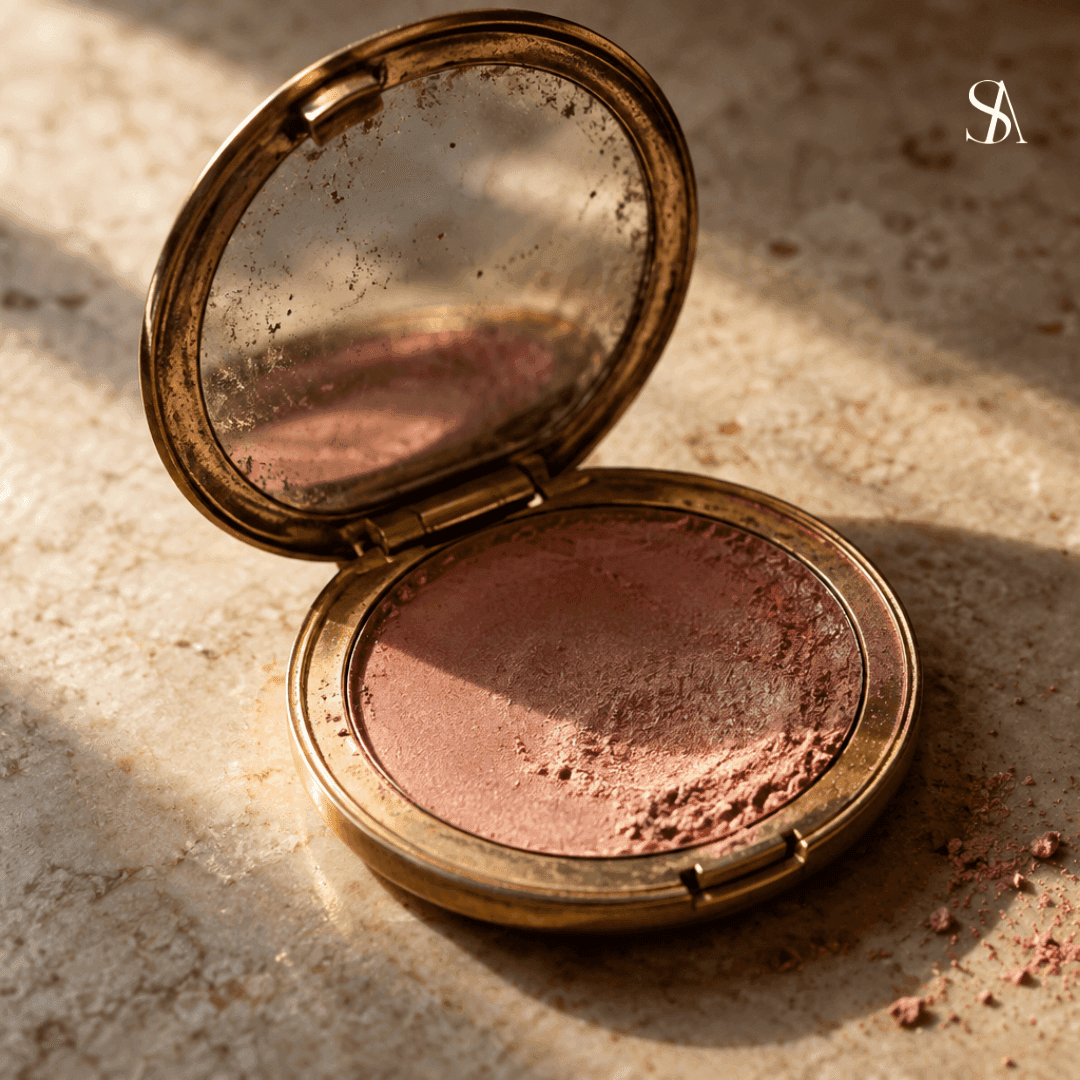
Makeup history is ultimately a history of people standing in front of mirrors and deciding what they want to see looking back at them. The products change, the techniques change, and the cultural meanings change, but the ritual remains surprisingly constant. Someone opens a compact, picks up a brush, leans toward the mirror, and makes a small decision about her own face.
Years later, that decision becomes part of the historical record.
The makeup we are wearing now will become nostalgic to someone else. The products we think are revolutionary will become dated. The techniques we learned from TikTok will eventually look as recognizable as the contour of the 2010s or the frosted lips of the early 2000s. Someone will look at a photograph of us twenty years from now and immediately know when it was taken, even if we cannot imagine that our makeup could ever look old-fashioned.
The next beauty boom will probably arrive quietly at first, disguised as another TikTok technique or a product that seems strangely specific until suddenly everyone wants it. It could be another iteration of the lip stain, a new way of diffusing color, a K-beauty texture that crosses into the mainstream, or a return to a forgotten cosmetic that feels completely new to the generation discovering it. The pattern is already familiar enough to make one thing fairly certain: whatever comes next will probably emerge as a reaction to what we have just spent years doing.
For now, beauty appears to be loosening its grip on perfection, but that does not mean beauty culture has suddenly become free of rules. Trends will continue to tell us what is desirable, brands will continue to turn cultural shifts into products, and algorithms will continue finding new ways to place idealized faces in front of us. What has changed is the growing space between those influences and the person standing in front of the mirror.
For generations, makeup has reflected the culture around it while quietly helping shape that culture in return. Now, after all those faces, perhaps the most interesting possibility is that makeup can simply be fun again because there is something liberating about remembering that cosmetics were never meant to give us one final, universally beautiful face.
They were meant to give us options.