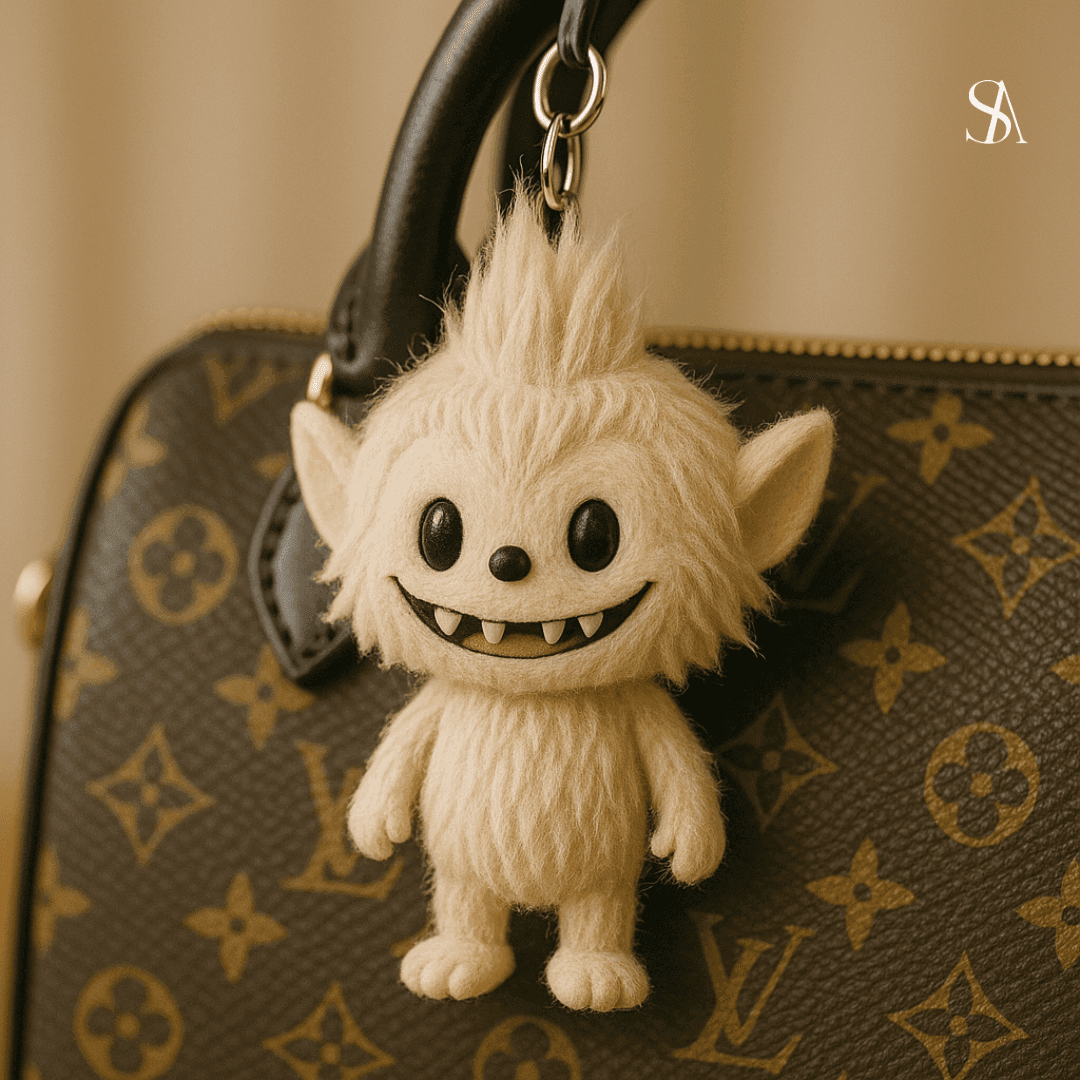
How a collection of deliberately ugly plush toys became the ultimate symbol of modern emotional consumption
The image is jarring at first glance: a sleek Hermès Birkin bag, worth more than most people’s annual salary, adorned with what appears to be a malformed elf with jagged teeth and vacant eyes. Yet this pairing — luxury leather goods meets deliberately grotesque plush charm — has become the defining aesthetic of 2025’s most unexpected cultural phenomenon. The creature in question is Labubu, a “monster” toy that has captured the collective imagination of millions, from K-pop superstars to suburban teenagers, creating a billion-dollar market built on the simple human need to nurture something small and imperfect.
But Labubu is more than just another collectible fad. The yellow-toothed, elf-eared figurines represent a fascinating convergence of psychological vulnerability, economic anxiety, and the profound human need for companionship in an increasingly isolating world. They are neither quite pet nor child, neither luxury nor necessity — they exist in a liminal space that reveals something deeply unsettling about contemporary emotional life.
The Architecture of Addiction
To understand Labubu’s grip on the global psyche, one must first examine the deliberate psychological manipulation embedded in its distribution system. Pop Mart, the Chinese company behind the phenomenon, has perfected what behavioral economists call “variable reward scheduling” — the same neurological pathway exploited by slot machines, dating apps, and social media platforms.
Each Labubu comes sealed in an opaque box, its contents unknown until purchase. This blind-box format triggers a cascade of neurochemical responses: the anticipation floods the brain with dopamine, while the uncertainty activates the same reward circuits that make gambling addictive. Unlike a traditional toy purchase, where satisfaction is immediate and finite, Labubu collecting becomes a self-perpetuating cycle of desire and temporary fulfillment.
Dr. Sarah Chen, a behavioral psychologist at Stanford, explains the phenomenon: “The blind box exploits our brain’s prediction error mechanism. Each unopened box represents infinite possibility — it could be the rare variant you’ve been seeking, or another common figure. That uncertainty is neurologically intoxicating.”
The numbers bear this out. Pop Mart reported that the average Labubu collector purchases 7.3 figures before acquiring their desired variant. Some devotees have documented spending thousands of dollars chasing elusive “secret” editions, their purchases resembling less a hobby than a compulsion.
The Comfort of Controlled Chaos
Yet addiction alone cannot explain Labubu’s emotional resonance. These toys arrive at a moment when traditional sources of comfort — stable relationships, predictable career paths, homeownership — feel increasingly elusive to young adults. In their deliberate imperfection, Labubu figures offer something radical: permission to love the unloved.
The “ugly-cute” aesthetic, known in Japanese as *kimo-kawaii*, deliberately subverts conventional beauty standards. Labubu’s crooked teeth, asymmetrical features, and slightly menacing expression make it seem vulnerable rather than threatening — a monster that needs protection rather than one that provides it. This inversion taps into what psychologists call the “baby schema” response, the biological imperative that makes us protective of small, helpless creatures.
“There’s something deeply therapeutic about caring for something that society would typically reject,” observes Dr. Michael Brody, a child psychiatrist who has studied toy attachment behaviors. “Labubu gives people permission to express nurturing instincts without the judgment that might come with more conventionally ‘childish’ toys.”
Social media posts reveal this dynamic in action. Collectors frequently refer to their Labubu figures as their “children” or “babies,” photographing them in elaborate domestic scenes — sleeping in miniature beds, sharing meals, accompanying their owners on daily errands. The toys become emotional support objects disguised as fashion accessories, offering the comfort of companionship without the complexity of human relationships.
Echoes from the Past
This is not the first time a generation has sought solace in surrogate companions. The parallels to previous cultural phenomena are striking and instructive.
In 1975, advertising executive Gary Ross Dahl introduced the Pet Rock, marketing it as “the perfect pet” that required no feeding, walking, or attention. The absurdity was intentional — Dahl was simultaneously mocking and fulfilling a genuine need for low-maintenance companionship. The Pet Rock sold 1.5 million units in its first year, becoming a cultural phenomenon that reflected both economic anxiety and social isolation in post-Vietnam America.
Two decades later, Beanie Babies created a similar frenzy, but with higher emotional stakes. Ty Warner’s deliberately limited production runs created artificial scarcity, while the toys’ innocent animal forms triggered protective instincts. Collectors formed elaborate communities, trading information about rare variants and retirement schedules. The secondary market reached such heights that some Beanie Babies sold for thousands of dollars, transforming childhood toys into investment vehicles.
What distinguishes Labubu from these predecessors is its explicit embrace of ugliness. Where Pet Rocks were neutral and Beanie Babies conventionally cute, Labubu figures are deliberately off-putting. This aesthetic choice reflects a broader cultural shift toward authenticity over perfection, vulnerability over strength. In an era of Instagram filters and AI-generated beauty, choosing to love something ugly becomes a form of rebellion.
The Pandemic Paradigm
The timing of Labubu’s rise cannot be separated from the global trauma of recent years. The COVID-19 pandemic fundamentally altered human relationships with space, touch, and companionship. As lockdowns confined millions to their homes, the need for tactile comfort intensified. Small, portable objects that could provide emotional regulation became essential survival tools.
Dr. Jennifer Aaker, a consumer psychologist at Stanford Graduate School of Business, has documented what she calls “compensatory nurturing” — the tendency to seek caregiving experiences during periods of powerlessness. “When people feel they have little control over their external environment, they often turn to objects they can completely control and care for,” she explains. “Labubu figures offer that sense of agency in miniature.”
The pandemic also accelerated the digitization of community. Labubu collecting flourished on TikTok, where users created elaborate “unboxing” videos, shared trading tips, and showcased their collections. These digital interactions provided the social connection that physical isolation had severed, creating what anthropologist Sherry Turkle calls “tethered intimacy” — relationships mediated by objects and screens rather than direct human contact.
The Economics of Emotional Labor
Perhaps most revealing is Labubu’s position within what economists call the “lipstick effect” — the tendency for consumers to purchase small luxuries during economic downturns. At roughly $15–30 per figure, Labubu toys occupy a sweet spot between impulse purchase and considered luxury. They offer the psychological benefits of retail therapy without the financial devastation of major purchases.
This accessibility has democratized what was once elite behavior. Where previous generations might have collected art or antiques as status symbols, Labubu collectors can build impressive displays on modest budgets. The toys become markers of cultural capital rather than economic capital — symbols of being “in the know” rather than simply wealthy.
Celebrity endorsements have amplified this effect. When Blackpink’s Lisa attached a Labubu to her Celine bag, or when Rihanna was photographed with one, they weren’t just modeling accessories — they were demonstrating a new form of luxury that prioritized emotional resonance over price tags. The message was clear: true sophistication meant embracing the unconventional.
The Mothering Impulse
What emerges from studying Labubu’s cultural impact is a portrait of a generation searching for outlets for their nurturing instincts in a world that offers few traditional opportunities for care.
Rising housing costs delay homeownership and family formation. Climate anxiety makes parenthood feel irresponsible. Economic uncertainty makes pet ownership seem impractical.
Into this void steps Labubu — a creature that demands nothing but offers everything. It requires no feeding, produces no waste, never ages or dies. It can be dressed, arranged, photographed, and displayed. It provides the satisfaction of caring without the responsibility of consequence.
“We’re seeing a generation that wants to practice nurturing in a low-stakes environment,” observes Dr. Rachel Calogero, a social psychologist who studies consumer behavior. “Labubu figures let people experience the emotional rewards of caregiving without the financial or temporal commitments that traditional dependents require.”
This dynamic reveals something profound about contemporary emotional life. The same generation that delays marriage and childbearing is simultaneously investing tremendous energy in caring for inanimate objects. They are, in essence, practicing love on things that cannot love them back — a form of emotional training that may say more about our cultural moment than any economic indicator.
The Future of Feeling
As Labubu’s initial frenzy begins to stabilize into sustained popularity, questions emerge about what this phenomenon represents for the future of human emotional expression. Are these toys filling a temporary void that will disappear as traditional life milestones become more accessible? Or do they represent a permanent shift toward object-mediated emotional relationships?
The answer likely lies somewhere between these extremes. Labubu succeeds because it offers something that human relationships cannot: complete emotional safety. There is no risk of rejection, abandonment, or disappointment. The toys provide unconditional positive regard in physical form — a therapeutic ideal that real relationships can rarely maintain.
Yet this safety comes at a cost. By investing emotional energy in objects rather than people, collectors may be inadvertently reinforcing the very isolation that makes such toys necessary. The question becomes whether Labubu figures serve as emotional training wheels that eventually lead to human connection, or as substitutes that replace it entirely.
The Monster in the Mirror
Ultimately, the Labubu phenomenon reveals less about toys than about ourselves. In our willingness to embrace deliberate ugliness, to invest love in the unloved, to practice nurturing on the non-living, we expose the profound emotional hunger that characterizes contemporary life. These yellow-toothed monsters become mirrors, reflecting our own needs back to us in a form we can finally acknowledge and address.
The genius of Labubu lies not in its design — though the aesthetic is carefully calibrated — but in its timing. It arrives precisely when we need permission to be tender, to be nurturing, to love something small and strange and imperfect. In a world that often feels too large and complex and frightening to comprehend, these tiny monsters offer a manageable outlet for our deepest human impulses.
They are, in the end, not really monsters at all. They are mirrors, reflecting our capacity for love in its most distilled form — love without expectation, without reciprocity, without fear. And perhaps, in learning to love these deliberate imperfections, we might remember how to love our own.