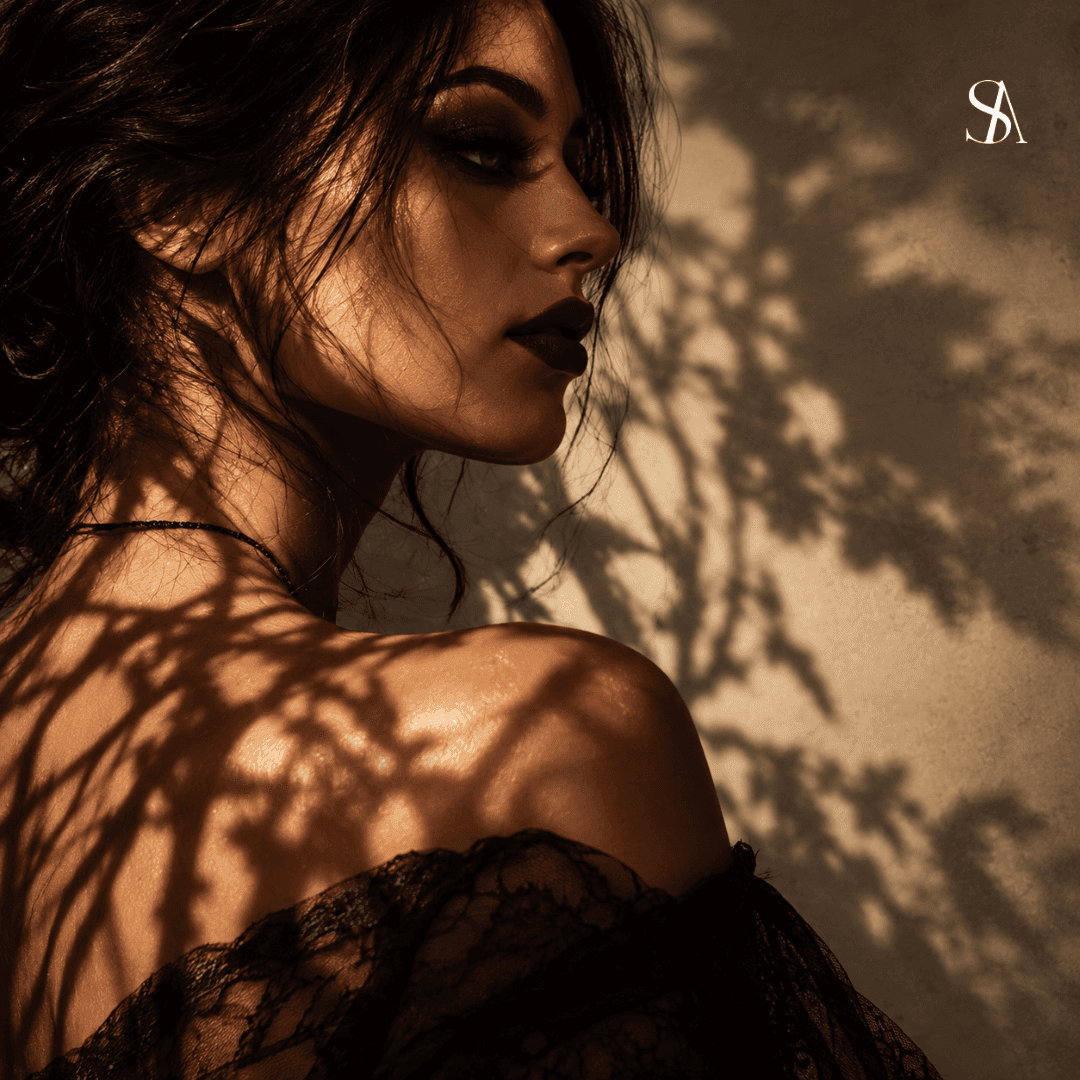
Once imagined as the ugly woman lurking at the edge of society, the witch has become a beauty muse, a Halloween favorite, and an unlikely symbol of feminine power.
Every October, the witch makes her annual return, although calling it a return feels a little misleading when she never really left. She appears on our mood boards with smudged black eyeliner, dark lips, silver jewelry, and hair that looks as though it has spent the afternoon wandering through an enchanted forest. She sells us perfumes that smell of smoke and midnight flowers, inspires makeup collections built around shadows and mystery, and gives us an excuse to wear black from head to toe without anyone asking if we are going through something. Somewhere between the pointed hat and the perfectly blended smoky eye, the witch stopped being the woman we were supposed to fear and became the woman whose look we wanted to recreate.
It is a curious transformation for a figure whose appearance was once designed to make her undesirable. In the familiar fairy-tale version, the witch is an old woman with a crooked nose, tangled hair, warts, and a face that seems to tell us everything we need to know about her character before she has even opened her mouth. Her ugliness is rarely incidental; it is part of the warning. Beauty belongs to the innocent princess, while the woman who possesses too much knowledge, too much ambition, or too much power is frequently pushed toward something grotesque. Yet modern beauty culture has found a way to take the same features that once signaled danger and turn them into inspiration, leaving us with a question more interesting than whether witches are having a moment: why are we so fascinated by the beauty of women who refuse to be harmless?
A Face Designed to Frighten Us
The witch’s familiar appearance did not simply emerge from centuries of people independently imagining the same spooky woman. The now-iconic pointed hat, broomstick, and other recognizable features have a history of their own. Cultural histories of witch imagery have traced the spread of these visual conventions to early modern European pamphlets, which helped circulate particular depictions of witches through print culture. As these images were reproduced, certain details became increasingly familiar, eventually helping shape the witch we recognize today (Eschner). In other words, the Halloween witch is partly the result of a very old form of mass media: an image reproduced often enough that generations eventually learned to recognize it.
But the face of the witch carried more than a collection of spooky accessories. Across European folklore, religious imagery, literature, and later popular entertainment, she became a figure onto whom anxieties about women’s power could be projected. Women who stepped outside accepted social roles, possessed knowledge that others did not understand, or lived at the margins of their communities could become objects of suspicion. The historical persecution of people accused of witchcraft was complex and varied by place and period, and it would be inaccurate to imagine every accusation as a simple case of a powerful woman being punished for her independence. Still, the witch’s enduring association with the threatening woman tells us something about the fears that shaped her image.
As Chloé Germaine Buckley explores through The Open University’s OpenLearn, the witch has repeatedly served as a warning against women who exercise power beyond the limits society considers acceptable. In fairy tales, the old witch often becomes the opposite of the beautiful young heroine, turning age, appearance, and female authority into visual shorthand for danger (Buckley). The result is an archetype in which the woman’s face appears to reveal a moral truth: the beautiful woman is good, the frightening woman is bad, and the woman who refuses to fit neatly into either category is someone to watch.
The irony is that this image was never as fixed as we might imagine. Historical Halloween postcards from the early twentieth century offer a fascinating counterpoint to the familiar wart-covered witch. Some illustrations from the period, particularly those circulated between 1905 and 1915, portrayed witches as beautiful sorceresses with blushed cheeks and conventionally attractive features. The historian Daniel Gifford has discussed these images in connection with the changing expectations placed on women at the time, when conversations about work, marriage, and political participation were reshaping ideas about female independence.
One interpretation is that the beautiful witch offered a way to imagine a woman who possessed power without giving up her attractiveness (Gambino). The glamorous witch, then, did not suddenly appear when dark lipstick became fashionable or when social media discovered the word witchcore. She has been changing her face for more than a century.
The Woman Behind the Wickedness
There is a reason the witch works so well as a beauty muse: she offers something that conventional beauty ideals often struggle to accommodate. She can be seductive without being sweet, mysterious without being shy, and beautiful without appearing particularly interested in being liked. Her appeal does not depend on looking approachable in the way that so much contemporary beauty imagery does, where skin is expected to glow, hair should look effortless, and even a dramatic makeup look must somehow suggest that its wearer woke up that way.
The witch operates under different rules. Her beauty can be theatrical, excessive, or deliberately unsettling. A dark lip does not have to make her look softer, a sharp eye does not have to be balanced by a barely-there complexion, and a face that commands attention does not need to apologize for taking up space. The point is not necessarily to look pretty in the traditional sense, but to create an impression. She enters a room as a character rather than an accessory.
Cinema has played a significant role in making this version of the witch so compelling. In The Wizard of Oz (1939), Margaret Hamilton’s Wicked Witch of the West became one of the most recognizable examples of the frightening witch, with green skin, a pointed hat, and a face deliberately styled to look menacing. Decades later, films and television began offering more varied interpretations, from the teenage rebellion of The Craft (1996) to the domestic magic of Practical Magic (1998). The witch could be frightening, funny, romantic, misunderstood, or simply the most interesting person in the room.
This shift has also been explored in discussions of witches in film and popular culture. The changing portrayals of witches — from grotesque villains to more glamorous, self-aware, and sometimes heroic figures — reflect a wider cultural interest in individuality, otherness, and female empowerment. These interpretations are not universal, and the witch has never been reduced to a single meaning. What changes is the possibility of seeing her from her own perspective rather than exclusively through the eyes of those who fear her (Donahue).
Consider the difference between being told a woman is dangerous because she has power and being invited to imagine what she might do with it. The first turns her into a warning; the second makes her a protagonist. That shift changes the way we look at her, and it changes which parts of her appearance we choose to admire.
Enter the Dark Feminine
Today, the witch’s visual language lives well beyond Halloween. It appears in gothic makeup, romantic black dresses, heavy silver rings, smoky fragrances, dramatic eyeliner, and the broader online fascination with what is often called the dark feminine. The label is loose, sometimes contradictory, and heavily shaped by social media, where complex ideas about femininity can become simplified into a makeup routine, a wardrobe, or a carefully curated mood board. Still, the aesthetic speaks to something recognizable: a desire to explore a version of womanhood that is less concerned with being agreeable and more interested in mystery, confidence, and control.
Beauty, after all, is not only about the features we are born with or the products we apply to them. It is also about the meanings attached to particular appearances. A dark lip can suggest glamour in one setting and defiance in another; pale makeup can evoke vintage cinema, a ghostly character, or a deliberately theatrical look. The products themselves do not carry a fixed personality, but culture teaches us how to read them. The witch offers an entire vocabulary of visual signals, and part of the pleasure is deciding which ones to borrow.
That does not mean every woman wearing black eyeliner is making a feminist statement, or that a Halloween costume is an act of rebellion. Sometimes a look is simply fun, and there is something refreshing about allowing beauty to be playful without requiring it to represent a larger social movement. But the enduring appeal of the witch suggests that her image offers more than an attractive collection of dark colors. She gives us a character through whom we can experiment with a different relationship to visibility, femininity, and the expectations placed upon women.
When the Villain Gets the Vanity Table
There is also something revealing about the way beauty culture has adopted the witch. The same figure who once represented an undesirable woman has become an aesthetic that can be packaged, photographed, and sold. Mystery now comes in a perfume bottle; rebellion can be purchased as a black lipstick; the appearance of someone who lives beyond society’s rules can be assembled through carefully chosen products. The witch has become both a symbol of resistance and an extremely marketable look.
That tension does not necessarily make the aesthetic meaningless. Fashion and beauty have always borrowed from characters, subcultures, and ideas that carry significance beyond their appearance. A person can enjoy the theatricality of a witch-inspired makeup look without claiming to share her beliefs or history. The more interesting question is what happens when a symbol of being outside the rules becomes another set of rules to follow.
Even the dark feminine can acquire its own beauty standards. The supposedly untouchable woman still needs the right face, the right clothes, the right kind of confidence, and the right photographs to communicate her mystique. What began as an escape from conventional femininity can become another carefully constructed ideal, complete with its own expectations about how a woman should look when she wants to appear powerful. The witch may have escaped the fairy tale, but she has not entirely escaped the beauty industry.
A Little Magic, a Little Defiance
The witch’s evolution is not a simple story about society finally deciding that women can be beautiful and powerful at the same time. The history is messier than that, and the old stereotypes have not disappeared just because the witch has become fashionable. Powerful women are still described through the language of monstrosity, while age, ambition, and unconventional appearances continue to influence the way women are judged. The witch remains recognizable partly because the tensions that shaped her never fully went away.
What has changed is our willingness to imagine her differently. We can look at the woman who was once cast as the villain and wonder what the story might have looked like from her side. We can admire the crooked smile, the dramatic silhouette, the unapologetic darkness, and the refusal to make herself smaller simply to reassure everyone else. We can even borrow a little of that energy for a night, whether it comes with a pointed hat or a particularly excellent smoky eye.
When Halloween arrives, the witch offers us a chance to play with the parts of ourselves that do not always fit neatly into everyday life. She reminds us that beauty can be strange, theatrical, imperfect, and a little intimidating, and that not every woman needs to look like the heroine of the story to be worth looking at. Sometimes, the most compelling face in the room belongs to the woman everyone was taught to fear.
And if that face happens to come with a black lip, a silver ring, and an excellent eyeliner wing, well, the witch has always understood the power of a good finishing touch.